
To begin your Indiana Criminal Record Expungement application, call 317-695-7700. I, Jeff Cardella, have personally handled thousands of expungements with over a 99% success rate. I provide a 100% MONEY BACK GUARANTEE on ALL expungements.
This guide explains portions of the Indiana expungement law in lay terms with the original text of the Indiana Expungement Statutes in black text and comments in red italics. This should help lay persons understand the law. Remember that this information is a summary and does not cover all exceptions. I strongly suggest speaking to an attorney about your particular situation.
This Guide concludes with a Frequently Asked Questions Section and the Indiana Expungement cheat sheets.
Quick Eligibility Summary (2026)
- Arrests or cases with no conviction – eligible after 1 year (many cases filed after June 30, 2022 are automatically expunged).
- Misdemeanor convictions – 5 years from the date of your last conviction.
- Level 6 or D felony convictions – 8 years from the date of your last conviction.
- Major felonies – 8 or 10 years from the date of your last conviction (the Court has discretion and prosecutor consent is often required).
Early Expungement Is Possible
The waiting period can often be waived if the prosecutor agrees in writing. I have successfully obtained early expungements in many counties when clients have strong reasons (new job offer, housing needs, etc.).
The Indiana Expungement Statutes Explained (IC 35-38-9)
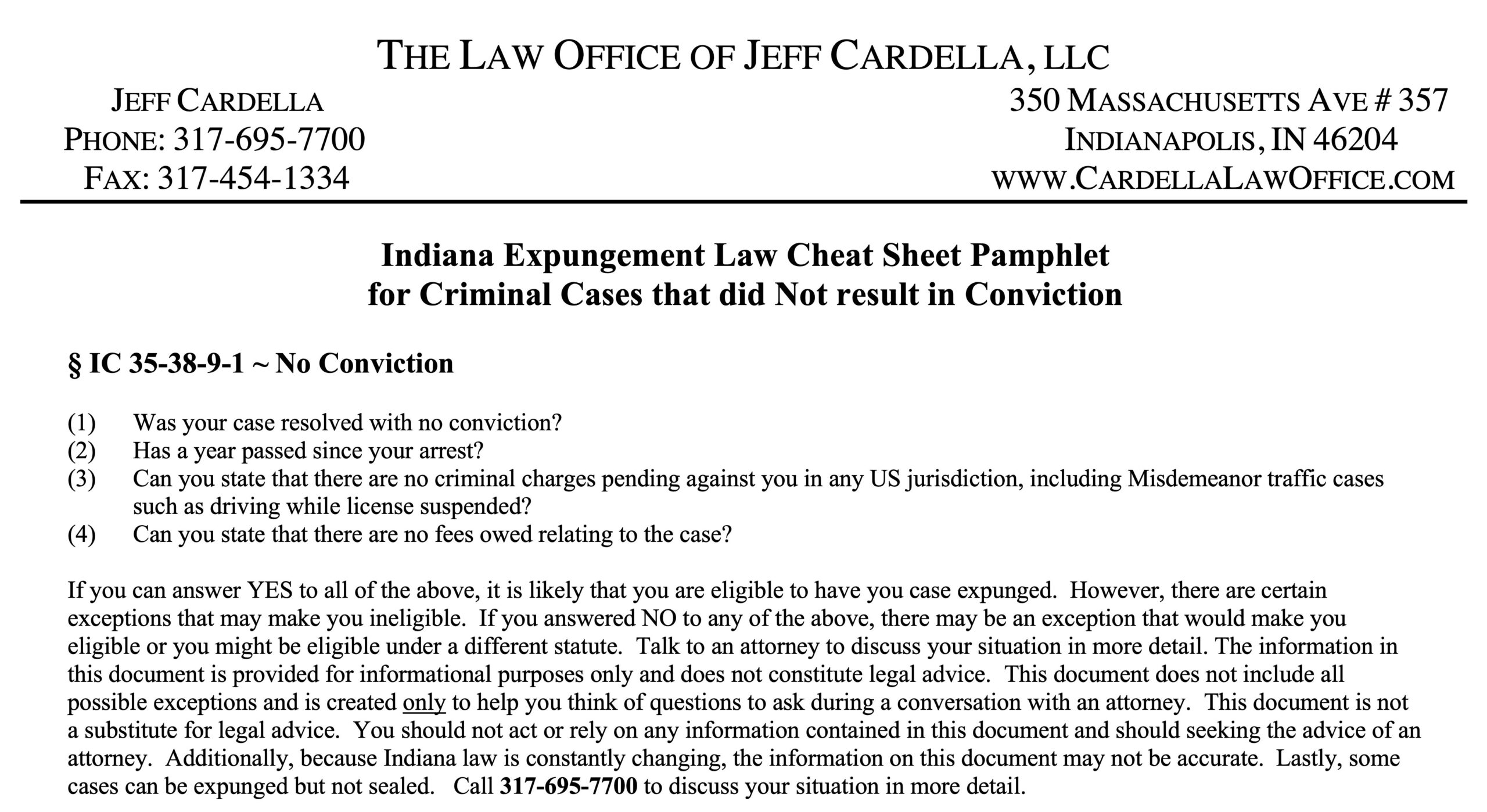
IC 35-38-9-1 Expunging Arrest Records
(a) This section applies only to a person who has been arrested, charged with an offense, or alleged to be a delinquent child, if: (1) the arrest, criminal charge, or juvenile delinquency allegation: (A) did not result in a conviction or juvenile adjudication, even if the arrest, criminal charge, or juvenile delinquency allegation resulted in an adjudication for an infraction; or (B) resulted in a conviction or juvenile adjudication and the conviction or adjudication was expunged under sections 2 through 5 of this chapter, or was later vacated; and (2) the person is not currently participating in a pretrial diversion program, unless the prosecuting attorney authorizes the person to petition for an expungement under this section.
Section 1 of the Indiana Expungement law applies to people who were found not guilty or had their case dismissed.
(b) This subsection applies to a person charged with an offense or alleged to be a delinquent child after June 30, 2022. If: (1) a court dismisses all: (A) criminal charges; or (B) juvenile delinquency allegations; filed and pending against a person; (2) one (1) year has passed since juvenile delinquency allegations were filed against a child, and: (A) there is no disposition; and (B) the state is not actively prosecuting the allegations; or (3) in a: (A) criminal trial a defendant is acquitted of all charges, or the defendant’s conviction is later vacated; or (B) juvenile proceeding the court finds all allegations not true, or the juvenile’s true finding is later vacated; the court shall immediately order all records related to the criminal charges or juvenile delinquency allegations expunged. An expungement order that is issued based on nonprosecution under subdivision (2) goes into effect immediately. An expungement order issued under subdivision (1) or (3) may not go into effect earlier than sixty (60) days from the date of the dismissal, acquittal, or no true finding. However, upon motion by the prosecuting attorney, if the court finds that specific facts exist in the particular case which justify a delay, the court may delay implementation of an expungement order under subdivision (1) or (3) for up to one (1) year from the date of the dismissal, acquittal, or no true finding.
For all judgments after June 30, 2022, expungement is automatic for all dismissed cases and all cases where the defendant is found not guilty.
(c) This subsection applies to a person arrested after June 30, 2022. If: (1) a person is arrested; (2) one hundred eighty (180) days have elapsed since the date of the arrest; and (3) no charges are pending against the person; the prosecuting attorney shall notify a judge exercising criminal jurisdiction in the county (or a designated judge, if applicable) of these facts. Upon receipt of the notification, the judge shall immediately order the expungement of all records related to the arrest.
(d) Not earlier than one (1) year after the date of arrest, criminal charge, or juvenile delinquency allegation (whichever is later), if the person was not convicted or adjudicated a delinquent child, or the opinion vacating the conviction or adjudication becomes final, the person may petition the court for expungement of the records related to the arrest, criminal charge, or juvenile delinquency allegation. However, a person may petition the court for expungement at an earlier time if the prosecuting attorney agrees in writing to an earlier time.
For all cases prior to June 30, 2022, expungement is not automatic. Expungement may be filed one year after the date of the arrest if the case was dismissed or resulted in a not guilty verdict.
(e) A petition for expungement of records must be verified and filed in a circuit or superior court in the county where the criminal charges or juvenile delinquency allegation was filed, or if no criminal charges or juvenile delinquency allegation was filed, in the county where the arrest occurred. The petition must set forth: (1) the date of the arrest, criminal charges, or juvenile delinquency allegation, and conviction (if applicable); (2) the county in which the arrest occurred, the county in which the information or indictment was filed, and the county in which the juvenile delinquency allegation was filed, if applicable; (3) the law enforcement agency employing the arresting officer, if known; (4) the court in which the criminal charges or juvenile delinquency allegation was filed, if applicable; (5) any other known identifying information, such as: (A) the name of the arresting officer; (B) case number or court cause number; (C) any aliases or other names used by the petitioner; (D) the petitioner’s driver’s license number; and (E) a list of each criminal charge and its disposition, if applicable; (6) the date of the petitioner’s birth; and (7) the petitioner’s Social Security number. A person who files a petition under this section is not required to pay a filing fee.
This subsection explains what must be contained in the petition. Additionally, remember that all filings must also comply with the Indiana Rules of Civil Procedure.
(f) The court shall serve a copy of the petition on the prosecuting attorney.
For criminal cases that are dismissed or not guilty, the Court is responsible for service.
(g) Upon receipt of a petition for expungement, the court: (1) may summarily deny the petition if the petition does not meet the requirements of this section, or if the statements contained in the petition indicate that the petitioner is not entitled to relief; and (2) shall grant the petition unless: (A) the conditions described in subsection (a) have not been met; or (B) criminal charges are pending against the person.
For cases that resulted in a not guilty verdict or a dismissal, the Court can grant the petition without a hearing if the person is eligible.
(h) Whenever the petition of a person under this section is granted, or if an expungement order is issued without a petition under subsection (b) or (c): (1) no information concerning the arrest, criminal charges, juvenile delinquency allegation, vacated conviction, or vacated juvenile delinquency adjudication (including information from a collateral action that identifies the petitioner), may be placed or retained in any state central repository for criminal history information or in any other alphabetically arranged criminal history information system maintained by a local, regional, or statewide law enforcement agency; (2) the clerk of the supreme court shall seal or redact any records in the clerk’s possession that relate to the arrest, criminal charges, juvenile delinquency allegation, vacated conviction, or vacated juvenile delinquency adjudication; (3) the records of: (A) the sentencing court; (B) a court that conducted a collateral action; (C) a juvenile court; (D) a court of appeals; and (E) the supreme court; concerning the person shall be redacted or permanently sealed; and (4) with respect to the records of a person who is named as an appellant or an appellee in an opinion or memorandum decision by the supreme court or the court of appeals, or who is identified in a collateral action, the court shall: (A) redact the opinion or memorandum decision as it appears on the computer gateway administered by the office of technology so that it does not include the petitioner’s name (in the same manner that opinions involving juveniles are redacted); and (B) provide a redacted copy of the opinion to any publisher or organization to whom the opinion or memorandum decision is provided after the date of the order of expungement. The supreme court and the court of appeals are not required to redact, destroy, or otherwise dispose of any existing copy of an opinion or memorandum decision that includes the petitioner’s name.
When expungement is granted for a case where there was no conviction, the records are also sealed (meaning that members of the public cannot obtain the information from government agencies). Remember that this does not apply to non-government agencies.
(i) If the court issues an order granting a petition for expungement under this section, or issues an order for expungement without a petition under subsection (b) or (c), the order must include the information described in subsection (e).
When expungement is granted for a case where there was no conviction, the order must explain that sealing also applies.
(j) If a person whose records are expunged brings an action that might be defended with the contents of the expunged records, the defendant is presumed to have a complete defense to the action. In order for the plaintiff to recover, the plaintiff must show that the contents of the expunged records would not exonerate the defendant. The plaintiff may be required to state under oath whether the plaintiff had records in the criminal or juvenile justice system and whether those records were expunged. If the plaintiff denies the existence of the records, the defendant may prove their existence in any manner compatible with the law of evidence.
If someone has a record expunged and later brings a civil suit relating to the arrest, there is a possibility that the expunged records can be used.
(k) Records expunged or sealed under this section must be removed or sealed in accordance with this section, but may not be deleted or destroyed. Records expunged or sealed under this section remain available to the court and criminal justice agencies as needed to carry out their official duties.
The records are expunged and sealed. After government records are expunged and sealed, they are not available to the public, but they are not destroyed.
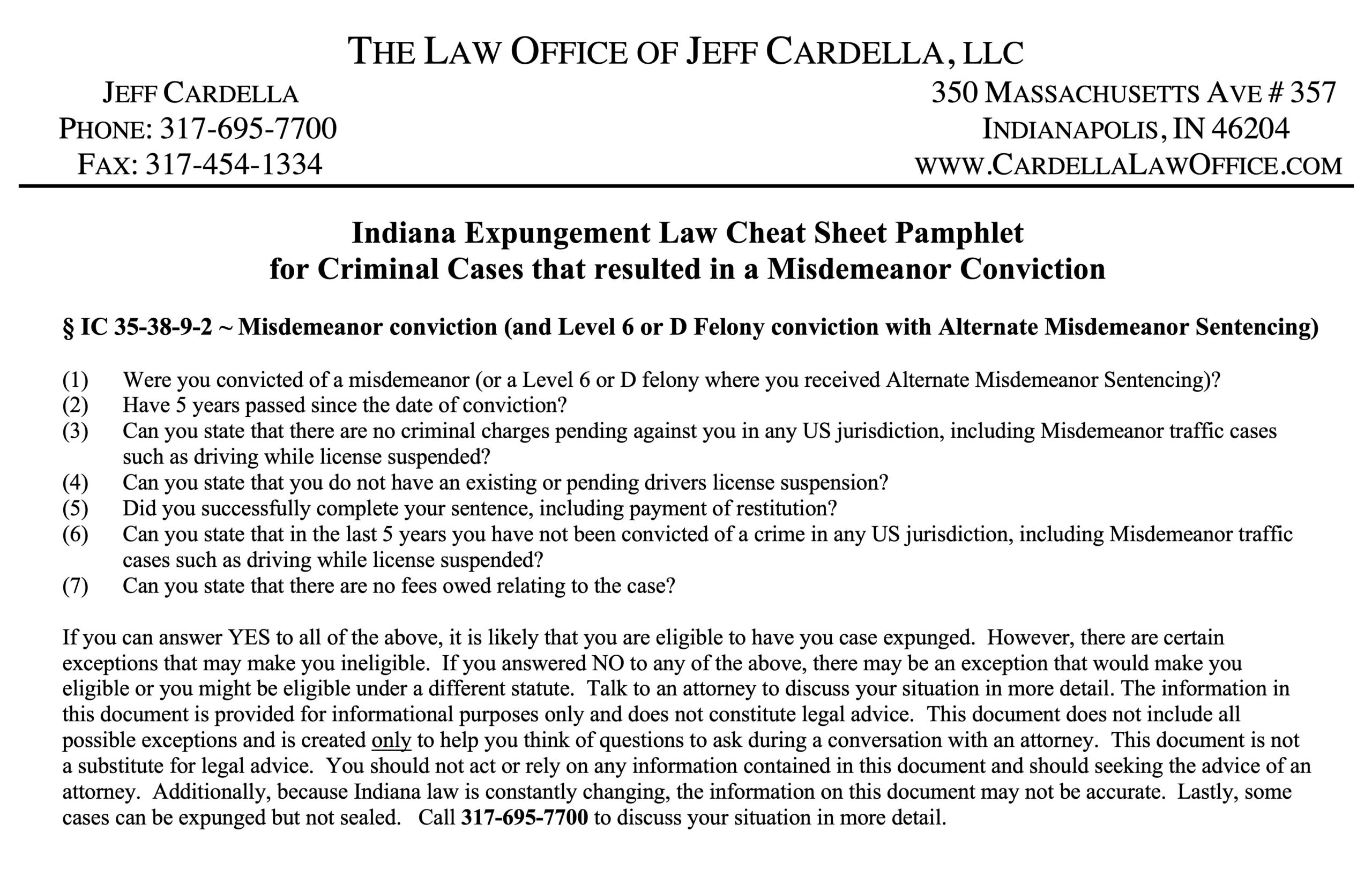
IC 35-38-9-2 Expunging Misdemeanor Convictions
(a) Except as provided in subsection (b) and section 8.5 of this chapter, this section applies only to a person convicted of a misdemeanor, including a Class D felony (for a crime committed before July 1, 2014) or a Level 6 felony (for a crime committed after June 30, 2014) reduced to a misdemeanor.
This section applies to criminal misdemeanors and criminal felonies that were reduced to misdemeanors.
(b) This section does not apply to the following: (1) A person convicted of two (2) or more felony offenses that: (A) involved the unlawful use of a deadly weapon; and (B) were not committed as part of the same episode of criminal conduct. (2) A sex or violent offender (as defined in IC 11-8-8-5).
This section does not apply to people who have two separate criminal felony convictions that involved the unlawful use of a deadly weapon or who are sex or violent offenders.
(c) Not earlier than five (5) years after the date of conviction (unless the prosecuting attorney consents in writing to an earlier period), the person convicted of the misdemeanor may petition a court to expunge all conviction records, including records contained in: (1) a court’s files; (2) the files of the department of correction; (3) the files of the bureau of motor vehicles; and (4) the files of any other person who provided treatment or services to the petitioning person under a court order; that relate to the person’s misdemeanor conviction.
A petition to expunge a criminal misdemeanor conviction can be filed 5 years after the date of the conviction or earlier if the prosecutor consents in writing.
(d) A person who files a petition to expunge conviction records shall file the petition in a circuit or superior court in the county of conviction.
The petition is filed in the county where the conviction occurred.
(e) If the court finds by a preponderance of the evidence that: (1) the period required by this section has elapsed; (2) no charges are pending against the person; (3) the person has paid all fines, fees, and court costs, and satisfied any restitution obligation placed on the person as part of the sentence; and (4) the person has not been convicted of a crime within the previous five (5) years (or within a shorter period agreed to by the prosecuting attorney if the prosecuting attorney has consented to a shorter period under subsection (c)); the court shall order the conviction records described in subsection (c) expunged in accordance with section 6 of this chapter.
For a criminal misdemeanor conviction, the Court MUST grant the petition if all requirements are met. The records will be expunged and sealed.
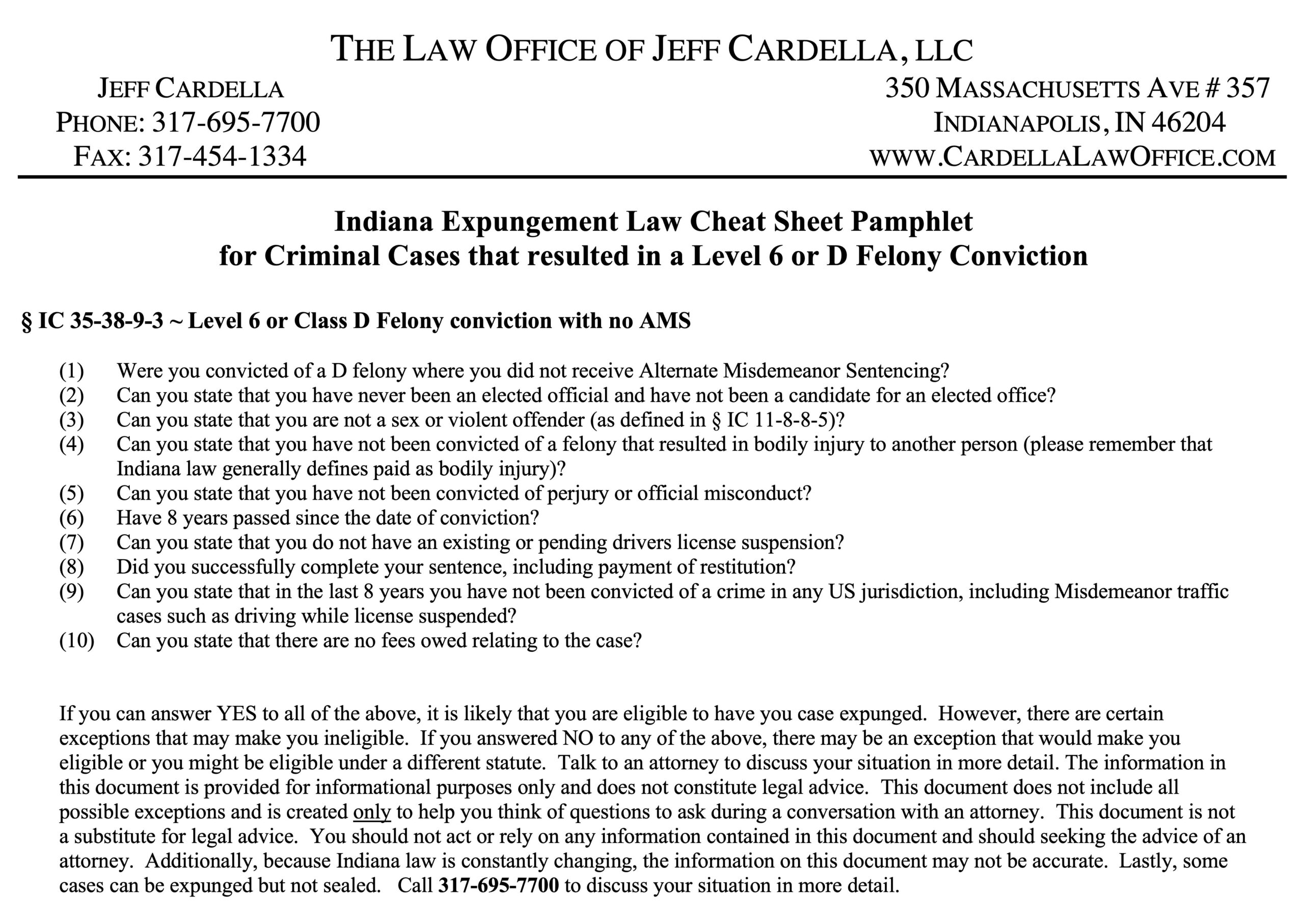
IC 35-38-9-3 Expunging Minor Class D and Level 6 Felony Convictions
(a) Except as provided in subsection (b) and section 8.5 of this chapter, this section applies only to a person convicted of a Class D felony (for a crime committed before July 1, 2014) or a Level 6 felony (for a crime committed after June 30, 2014). This section does not apply to a person if the person’s Class D felony or Level 6 felony was reduced to a Class A misdemeanor.
This section applies to Class D felony and Level 6 felony convictions that are not specifically excluded, such as convictions resulting in injury to another person.
(b) This section does not apply to the following: (1) An elected official convicted of an offense while serving the official’s term or as a candidate for public office. (2) A sex or violent offender (as defined in IC 11-8-8-5). (3) A person convicted of a felony that resulted in bodily injury to another person. (4) A person convicted of perjury (IC 35-44.1-2-1) or official misconduct (IC 35-44.1-1-1). (5) A person convicted of an offense described in: (A) IC 35-42-1; (B) IC 35-42-3.5; or (C) IC 35-42-4. (6) A person convicted of two (2) or more felony offenses that: (A) involved the unlawful use of a deadly weapon; and (B) were not committed as part of the same episode of criminal conduct.
This section does not apply to elected officials, sex or violent offenders, felonies resulting in bodily injury, perjury, official misconduct, or certain violent/sex offenses.
(c) Not earlier than eight (8) years after the date of conviction (unless the prosecuting attorney consents in writing to an earlier period), the person convicted of the Class D felony or Level 6 felony may petition a court to expunge all conviction records, including records contained in: (1) a court’s files; (2) the files of the department of correction; (3) the files of the bureau of motor vehicles; and (4) the files of any other person who provided treatment or services to the petitioning person under a court order; that relate to the person’s Class D or Level 6 felony conviction.
A petition to expunge a Class D felony or Level 6 felony conviction under this section can be filed 8 years after the date of the conviction (or earlier if the prosecutor consents in writing).
(d) A person who files a petition to expunge conviction records shall file the petition in a circuit or superior court in the county of conviction.
A petition for expungement must be filed in the county of conviction.
(e) If the court finds by a preponderance of the evidence that: (1) the period required by this section has elapsed; (2) no charges are pending against the person; (3) the person has paid all fines, fees, and court costs, and satisfied any restitution obligation placed on the person as part of the sentence; and (4) the person has not been convicted of a crime within the previous eight (8) years (or within a shorter period agreed to by the prosecuting attorney if the prosecuting attorney has consented to a shorter period under subsection (c)); the court shall order the conviction records described in subsection (c) expunged in accordance with section 6 of this chapter.
For a Class D felony or Level 6 felony conviction under this section, the Court MUST grant the petition if all requirements are met. The records will be expunged and sealed.
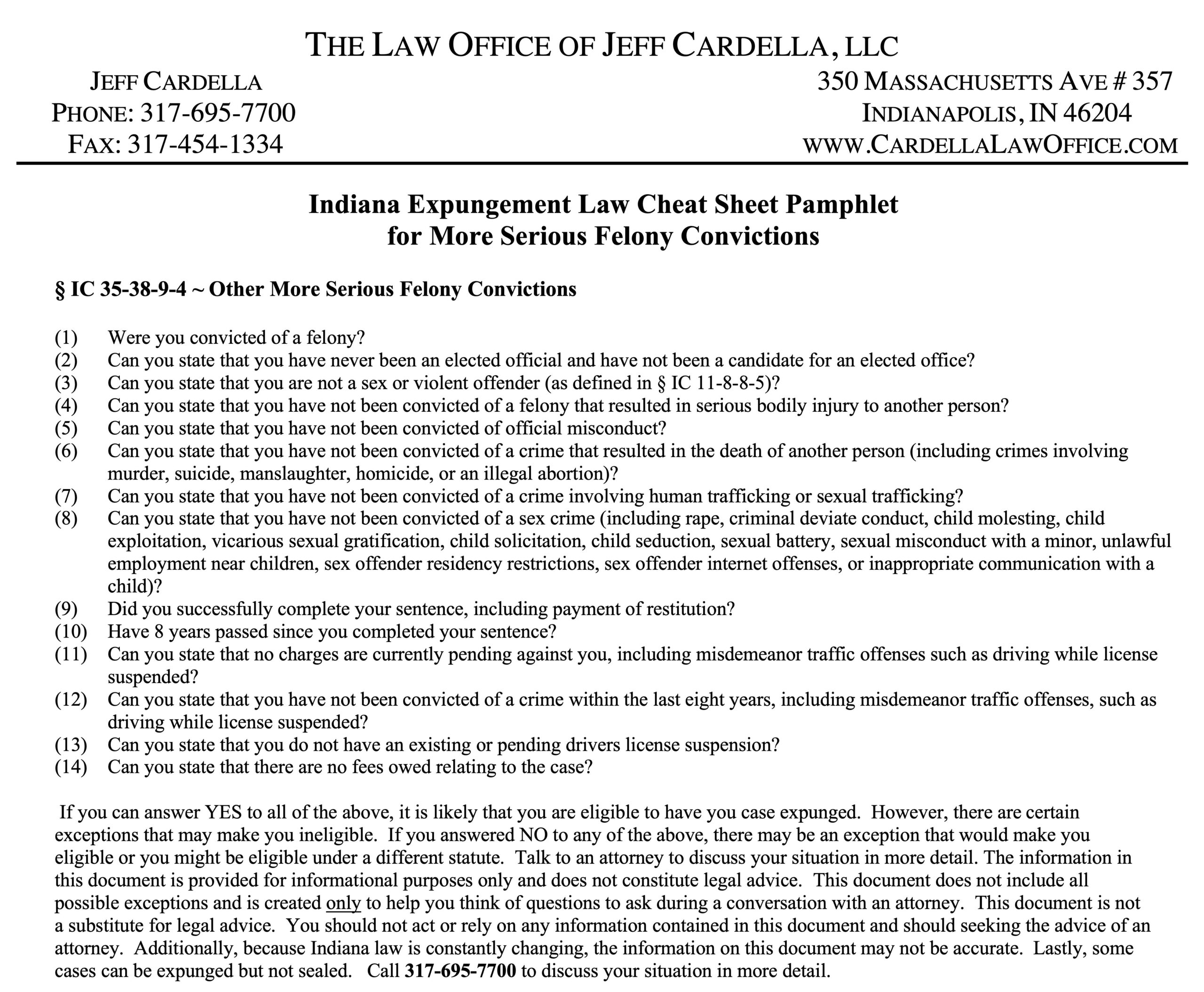
IC 35-38-9-4 Expunging Certain Less Serious Felony Convictions
(a) Except as provided in subsection (b) and section 8.5 of this chapter, this section applies only to a person convicted of a felony who may not seek expungement of that felony under section 3 of this chapter.
This section applies to Class D felony and Level 6 felony convictions that are not eligible for expungement under section 3 (such as convictions that resulted in injury to another person).
(b) This section does not apply to the following: (1) An elected official convicted of an offense while serving the official’s term or as a candidate for public office. (2) A sex or violent offender (as defined in IC 11-8-8-5). (3) A person convicted of a felony that resulted in serious bodily injury to another person. (4) A person convicted of official misconduct (IC 35-44.1-1-1). (5) A person convicted of an offense described in: (A) IC 35-42-1; (B) IC 35-42-3.5; or (C) IC 35-42-4. (6) A person convicted of two (2) or more felony offenses that: (A) involved the unlawful use of a deadly weapon; and (B) were not committed as part of the same episode of criminal conduct.
This section does not apply to elected officials, sex or violent offenders, felonies resulting in serious bodily injury, official misconduct, or certain violent/sex offenses.
(c) Not earlier than the later of eight (8) years from the date of conviction, or three (3) years from the completion of the person’s sentence, unless the prosecuting attorney consents in writing to an earlier period, the person convicted of the felony may petition a court to expunge all conviction records, including records contained in: (1) a court’s files; (2) the files of the department of correction; (3) the files of the bureau of motor vehicles; and (4) the files of any other person who provided treatment or services to the petitioning person under a court order; that relate to the person’s felony conviction.
A petition to expunge a felony conviction under this section can be filed 8 years from conviction or 3 years after sentence completion (or earlier if the prosecutor consents).
(d) A person who files a petition to expunge conviction records shall file the petition in a circuit or superior court in the county of conviction.
A petition for expungement must be filed in the county of conviction.
(e) If the court finds by a preponderance of the evidence that: (1) the period required by this section has elapsed; (2) no charges are pending against the person; (3) the person has paid all fines, fees, and court costs, and satisfied any restitution obligation placed on the person as part of the sentence; and (4) the person has not been convicted of a crime within the previous eight (8) years (or within a shorter period agreed to by the prosecuting attorney if the prosecuting attorney has consented to a shorter period under subsection (c)); the court may order the conviction records described in subsection (c) marked as expunged in accordance with section 7 of this chapter. A person whose records have been ordered marked as expunged under this section is considered to have had the person’s records expunged for all purposes other than the disposition of the records.
For major felony convictions under this section, the Court may grant the petition if all requirements are met, but the Court is not required to grant the petition. The records will be marked as expunged but remain visible to the public.
IC 35-38-9-5 Expunging Certain Serious Felony Convictions; Consent of Prosecutor Required
(a) Except as provided in subsection (b) and section 8.5 of this chapter, this section applies to a person convicted of a felony, including: (1) an elected official convicted of an offense while serving the official’s term or as a candidate for public office; and (2) a person convicted of a felony that resulted in serious bodily injury to another person.
This section applies to convictions that are not eligible for expungement under the other parts of the expungement law, such as public officials and convictions that involve serious bodily injury.
(b) This section does not apply to the following: (1) A sex or violent offender (as defined in IC 11-8-8-5). (2) A person convicted of official misconduct (IC 35-44.1-1-1). (3) A person convicted of an offense described in: (A) IC 35-42-1; (B) IC 35-42-3.5; or (C) IC 35-42-4. (4) A person convicted of two (2) or more felony offenses that: (A) involved the unlawful use of a deadly weapon; and (B) were not committed as part of the same episode of criminal conduct.
This section does not apply to sex or violent offenders, official misconduct, certain violent/sex offenses, or multiple deadly-weapon felonies.
(c) Not earlier than the later of ten (10) years from the date of conviction, or five (5) years from the completion of the person’s sentence, unless the prosecuting attorney consents in writing to an earlier period, the person convicted of the felony may petition a court to expunge all conviction records, including records contained in: (1) a court’s files; (2) the files of the department of correction; (3) the files of the bureau of motor vehicles; and (4) the files of any other person who provided treatment or services to the petitioning person under a court order; that relate to the person’s felony conviction.
A petition to expunge a serious felony conviction can be filed 10 years from conviction or 5 years after sentence completion (or earlier if the prosecutor consents).
(d) A person who files a petition to expunge conviction records shall file the petition in a circuit or superior court in the county of conviction.
A petition for expungement must be filed in the county of conviction.
(e) If the court finds by a preponderance of the evidence that: (1) the period required by this section has elapsed; (2) no charges are pending against the person; (3) the person has paid all fines, fees, and court costs, and satisfied any restitution obligation placed on the person as part of the sentence; (4) the person has not been convicted of a crime within the previous ten (10) years (or within a shorter period agreed to by the prosecuting attorney if the prosecuting attorney has consented to a shorter period under subsection (c)); and (5) the prosecuting attorney has consented in writing to the expungement of the person’s criminal records; the court may order the conviction records described in subsection (c) marked as expunged in accordance with section 7 of this chapter. A person whose records have been ordered marked as expunged under this section is considered to have had the person’s records expunged for all purposes other than the disposition of the records.
For serious felony convictions under this section, the Court may grant the petition if all requirements are met (including prosecutor consent). The records will be marked as expunged but remain visible to the public.
IC 35-38-9-6 Effect of Expunging Misdemeanor and Minor Class D and Level 6 Felony Convictions
(a) For expunged records under sections 2-3, the court shall: (1) Order the department of correction, bureau of motor vehicles, law enforcement, and service providers to prohibit record release without a court order, except to law enforcement acting officially. (2) Order the state police to seal expunged conviction records, disclosable only to authorized entities like prosecutors, defense attorneys, probation departments, FBI, DHS, supreme court, or motor vehicle agencies under specific conditions. (3) Notify the supreme court clerk to seal related records.
Expungement for misdemeanors and Level 6/D felonies results in sealing. Records are not destroyed but are hidden from the public.
(b) Except as noted, records of sentencing courts, juvenile courts, and appellate courts are permanently sealed, though driver’s license suspensions are unaffected.
(c) For appellate opinions naming the petitioner, the court redacts the name online and provides redacted copies to publishers, without destroying original copies.
(d) Prosecutors may apply to unseal records for new prosecutions, with resealing ordered when reasons cease, unless used in convictions or sentencing enhancements.
(e) Expungement does not affect sex offender registry operations or requirements.
(f) Domestic violence expungement does not restore firearm rights, which require IC 35-47-4-7.
(g) Expungement orders include information from section 8(b).
IC 35-38-9-7 Effect of Expunging Serious and Less Serious Felony Convictions
(a) Applies to petitions under sections 4 or 5 with records marked as expunged.
(b) Court and public records remain public but are marked as expunged. Driver’s license suspensions are unaffected.
(c) State police, motor vehicles, and law enforcement add an expunged entry to records. Motor vehicle reporting for traffic violations remains unaffected.
(d) Orders include information from section 8(b).
IC 35-38-9-8 Petition to Expunge Conviction Records
(a) Applies to petitions under sections 2-5, not section 1 (arrest, charge, or juvenile records).
(b) Petitions must include petitioner’s full name, aliases, date of birth, addresses since the offense, case number, affirmations of no pending charges or new crimes, conviction details, Social Security and driver’s license numbers, arrest and conviction dates, prosecutor’s consent if applicable, and prior petitions.
(c) Petitioners may include additional helpful information.
(d) A civil case filing fee is required, waivable for indigent petitioners.
(e) Petitions must be served to the prosecutor per Indiana Rules of Trial Procedure.
(f) Prosecutors inform victims of their rights, unless the court has no discretion in granting expungement.
(g) Prosecutors must reply within 30 days, or they waive objections, and the court proceeds under section 9.
IC 35-38-9-8.5 Expungement of Certain Offenses Punishable by an Indeterminate Sentence
(a) Applies to Indiana offenses with indeterminate sentences under laws other than IC 35-50.
(b) Misdemeanors at filing time can be petitioned under section 2.
(c) Level 6 felonies not similar to section 3(b) offenses can be petitioned under section 3.
(d) Offenses not eligible under section 3 and not similar to section 4(b) offenses can be petitioned under section 4.
(e) Felonies, including those in section 5(a) and not similar to section 5(b), can be petitioned under section 5.
IC 35-38-9-9 Duties of Court in Ruling on Expungement Petitions
(a) If the prosecutor does not object or waives objection, the court may grant expungement without a hearing.
(b) Petitions not meeting section 8 requirements or showing ineligibility may be summarily denied.
(c) If the prosecutor objects, they file reasons and serve the petitioner, with a hearing set no sooner than 60 days after service.
(d) Victims may submit statements at the hearing, and petitioners must prove petition facts by a preponderance of evidence.
(e) Grant or denial is an appealable final order.
(f) If granted, the court issues an expungement order per sections 6 and 7.
(g) Orders include section 8(b) information.
(h) Petitioners may expunge multiple convictions in one petition per county, filing separate petitions for different counties.
(i) Except as noted, only one expungement petition is allowed per lifetime, with petitions in multiple counties within 365 days counting as one.
(j) Denied petitions may be refiled for unexpunged convictions after three years if denied under sections 4 or 5 discretion.
(k) Amended petitions for new convictions require court findings of good faith, excusable neglect or uncontrollable circumstances, and justice interests.
IC 35-38-9-9.5 Collateral Action in a Different County
(a) Applies to collateral actions in a different county from the expungement county.
(b) Upon receiving a collateral action expungement request with a certified expungement order, the county court notifies the prosecutor and sets a hearing or orders expungement without a hearing if eligibility is clear.
(c) The court orders expungement (sections 1-3) or marking as expunged (sections 4-5) unless the action is unrelated.
(d) Requests can be filed anytime after the original expungement order.
(e) No filing fee is required for collateral action expungement requests, even under a new cause.
IC 35-38-9-10 Unlawful Discrimination Against a Person Whose Record Has Been Expunged; Exceptions
(a) Does not apply to those accessing sealed records under section 6(a)(2).
(b) It’s unlawful to suspend, expel, refuse employment, admission, licensing, or discriminate based on an expunged or sealed record.
(c) Except for section 6(f), expungement fully restores civil rights, including voting, holding office, firearm licensing, and jury service.
(d) Questions about criminal records must exclude expunged convictions or arrests.
(e) Expunged individuals are treated as never convicted, but expunged convictions may be considered in new prosecutions or sentencing.
(f) Discriminating based on expunged records is a Class C infraction, subject to contempt, with injunctive relief available.
(g) Expungement orders can be evidence of due care in hiring or licensing.
(h) Expunged convictions are inadmissible in negligent hiring or licensing actions.
(i) Expungement cases become confidential upon order issuance, but documents and hearings are public until then.
IC 35-38-9-11 Waiver of Expungement in a Plea Agreement Invalid
(a) Waiving expungement rights in a plea agreement is invalid and unenforceable.
(b) Waivers based on noncompliance with this chapter are valid.
IC 35-38-9-12 Penalties for Disclosing an Expunged Conviction
Criminal history providers disclosing expunged convictions are subject to penalties under IC 24-4-18-8.
Indiana Expungement FAQs: What You Need to Know
What is Indiana expungement?
Indiana expungement can seal many (not all) criminal records from public view under Indiana expungement law, preventing them from appearing on background checks.
Who is eligible for misdemeanor Indiana expungement?
Most misdemeanor convictions are eligible 5 years after conviction, provided no new convictions and all sentencing terms are complete.
Can felonies be expunged in Indiana?
Yes, many felonies qualify for felony Indiana expungement after 8–10 years, depending on the offense. Serious crimes like homicide or sex offenses are ineligible.
How long does Indiana expungement take?
The process typically takes 1–3 months, depending on court schedules and case complexity.
Can I expunge my record myself?
While Indiana expungement law allows pro se petitions, it’s not advisable. Expungement is routine for experienced attorneys but complex for individuals. Mistakes can lead to denials or procedural defects, costing more to fix than hiring an attorney initially (if they can be fixed). It’s like changing a car’s transmission—easy for a mechanic, but disastrous if you don’t know what you’re doing.
Can I expunge multiple records?
Yes, but all records in a single county must be included in one petition, and petitions across multiple counties must be filed within 365 days. Conviction expungements are a once-in-a-lifetime opportunity.
Does expungement restore gun rights?
Expungement may restore civil rights, including gun ownership, but federal laws and certain convictions (e.g., domestic battery) may still restrict firearm rights and may require a separate petition to restore firearm rights. Consult us for details as to how this will apply to your specific case.
Are expunged records completely destroyed?
Most expunged records are sealed, not destroyed, and remain accessible to law enforcement or under court order. Some juvenile records may be destroyed.
Is there a filing fee for expungement?
Non-conviction expungements have no filing fee. Conviction expungements require a filing fee and a fee to have the sheriff serve the petition.
Can eviction records be expunged?
Yes, recent changes to Indiana expungement law allow eviction record expungement, improving housing opportunities.
Indiana Expungement Cheat Sheet Pamphlets
Ready to clear your record?
Call today for a free consultation. I offer a full money-back guarantee on ALL expungements and serve every county in Indiana.
Phone: 317-695-7700
Email: jeffcardella@cardellalawoffice.com
Address: 350 Massachusetts Ave #357, Indianapolis, IN 46204
DISCLAIMER - The information contained on this website is provided for educational and informational purposes only, and should not be construed as legal advice or as an offer to perform legal services on any subject matter. The content of this web site contains general information and may not reflect current legal developments or information. The information is not guaranteed to be correct, complete or current. We make no warranty, expressed or implied, about the accuracy or reliability of the information at this website or at any other website to which it is linked. Recipients of content from this site should not act or refrain from acting on the basis of any information included in the site without seeking appropriate legal advice on the particular facts and circumstances at issue from an Indiana Criminal Defense attorney or attorney licensed in the recipient’s state. Nothing herein is intended to create an attorney-client relationship and shall not be construed as legal advice. This is not an offer to represent you, nor is it intended to create an attorney-client relationship.