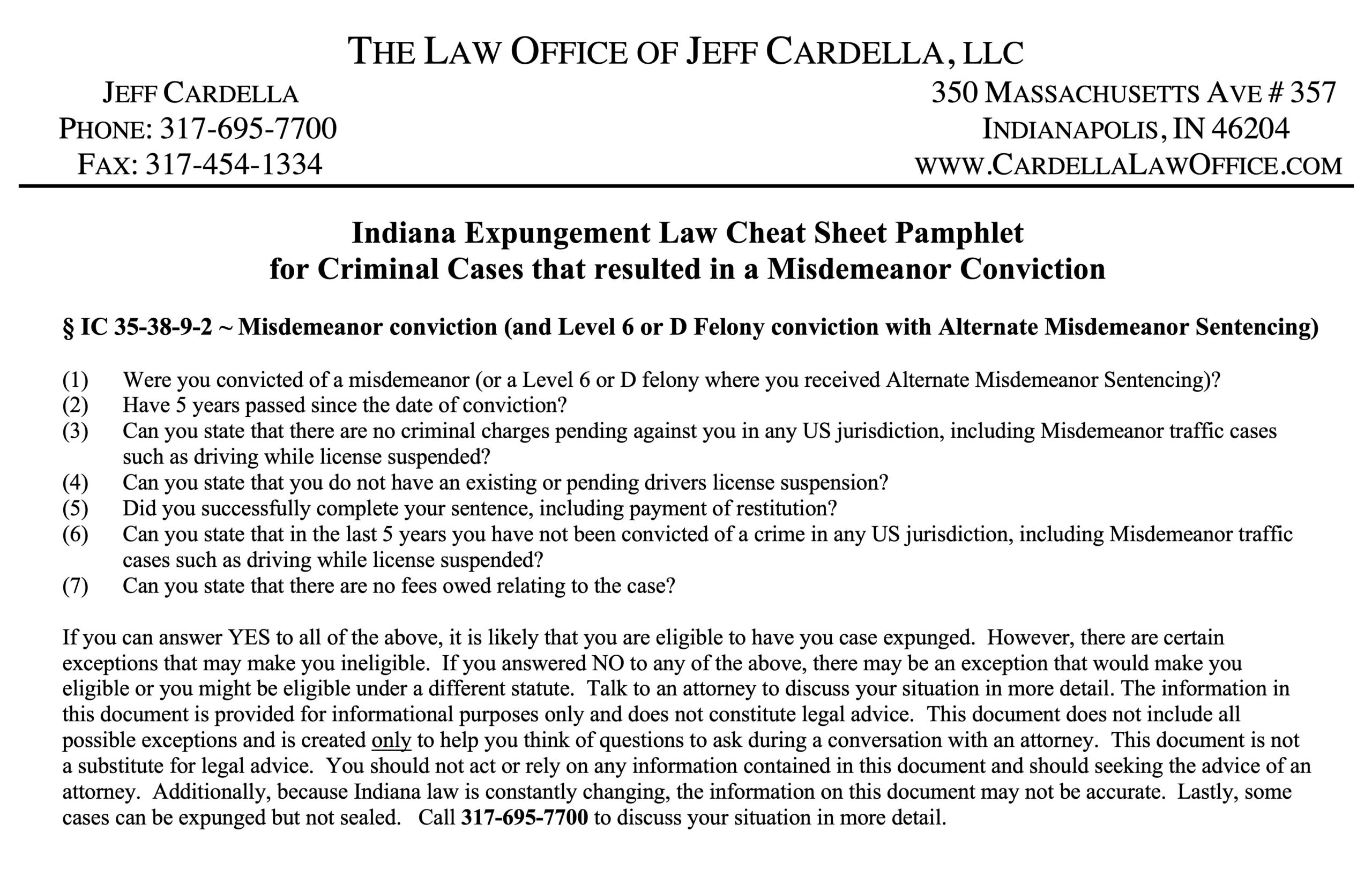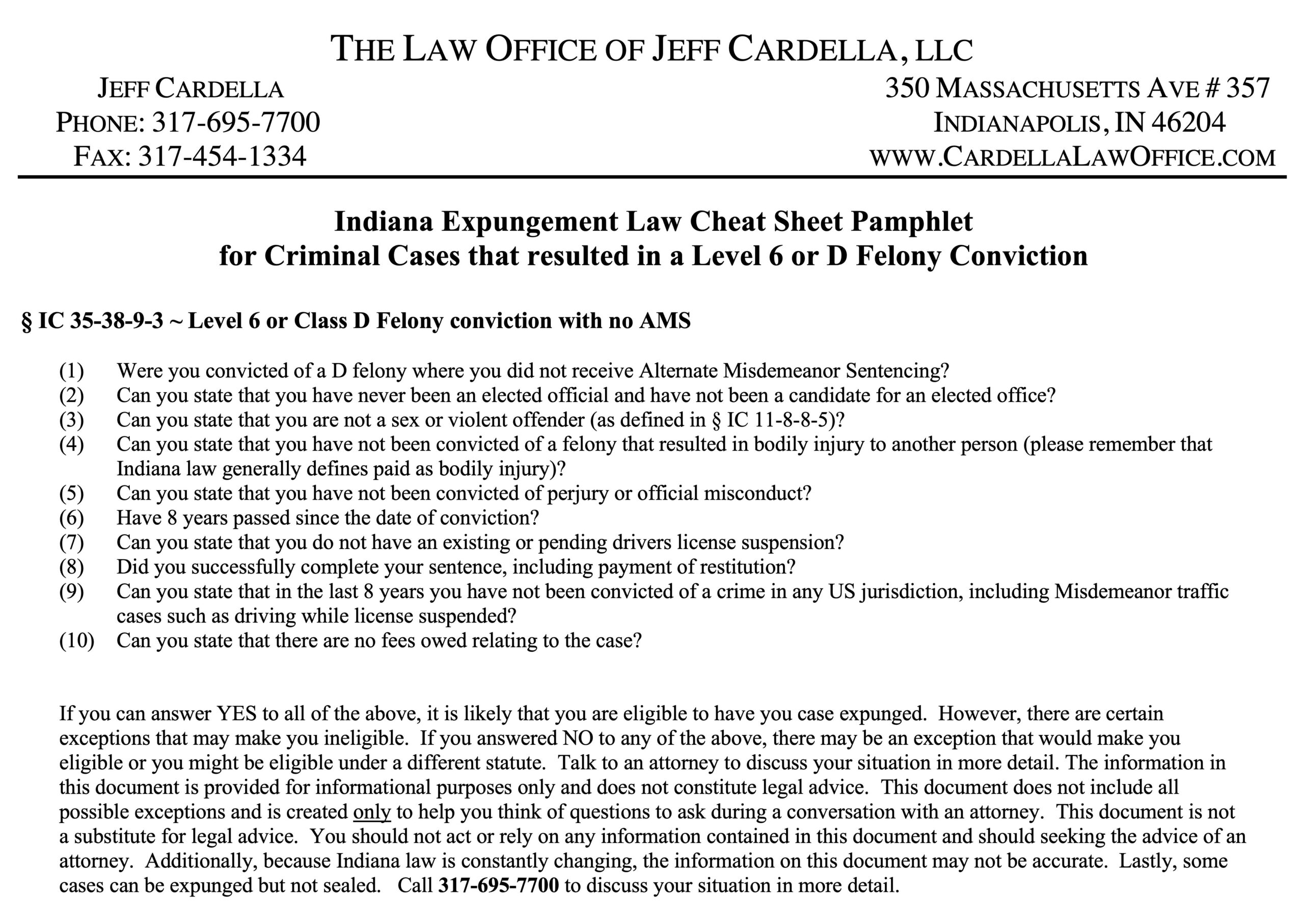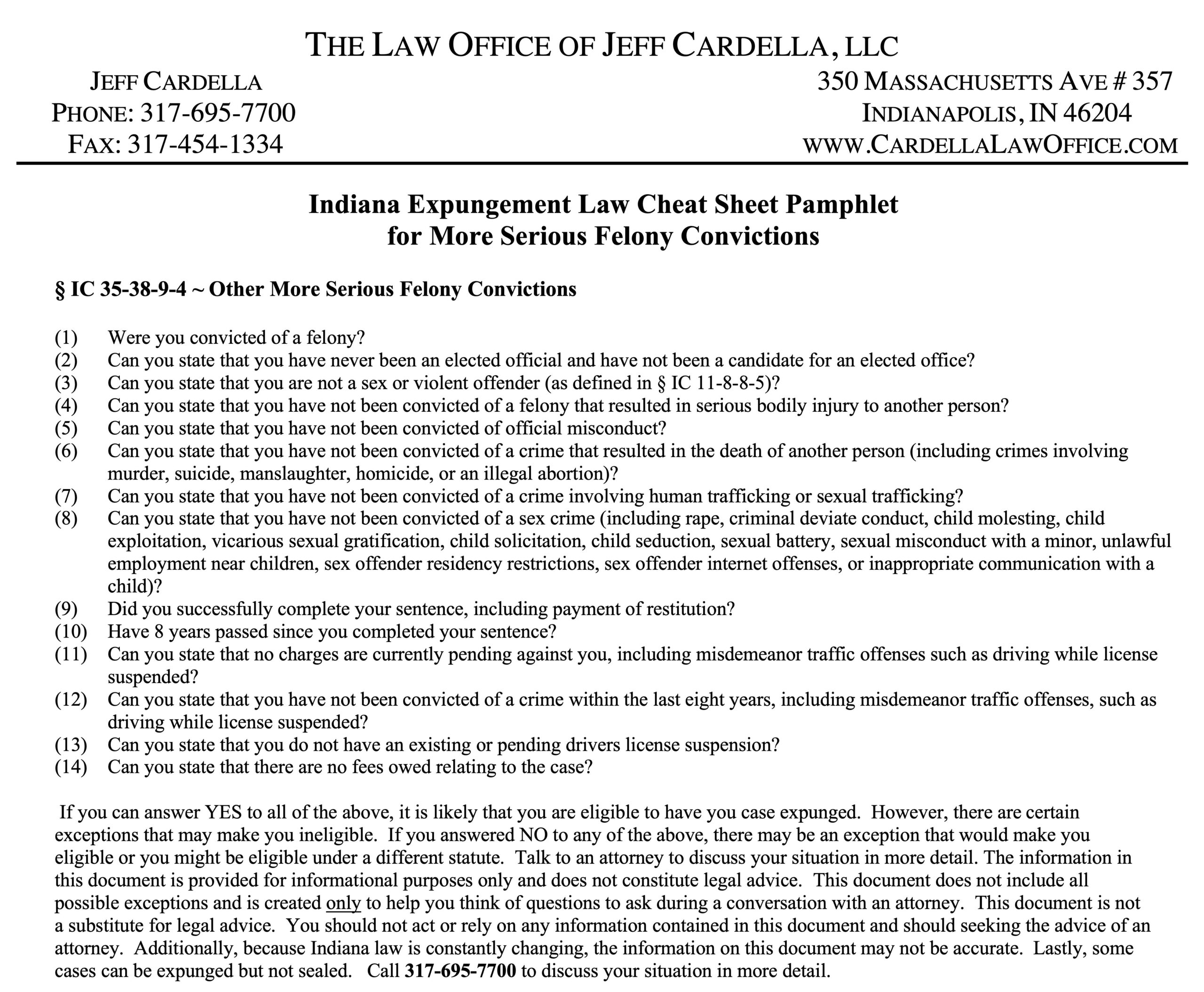
This guide explains portions of the Indiana expungement law in lay terms with the original text of the Indiana Expungement Statutes in black text and comments in red italics. This should help lay persons understand the law Remember that this information is a summary and does not cover all exceptions. I strongly suggest speaking to an attorney about your particular situation. This Guide concludes with a Frequently Asked Questions Section and the Indiana Expungement cheat sheets.

2025 Indiana Expungement Law Guide by Jeff Cardella

If you have questions about the Indiana Expungement Law, also known as the Indiana Second Chance Law, please review the 2025 Indiana Expungement guide below. I, Jeff Cardella, have successfully handled thousands of expungement petitions and have over a 99% success rate on expungement petitions. If you have any questions about your Indiana Expungement, you can call 317-695-7700 to schedule a free consultation with an Indiana expungement attorney or Indianapolis expungement lawyer to discuss sealing your criminal record under the Indiana Second Chance Law. I offer a MONEY BACK GUARANTEE ON ALL EXPUNGEMENTS. (Do not be fooled by attorneys who do not stand behind their work and do not offer a money back guarantee on ALL expungements.) You can also email me at jeffcardella@cardellalawoffice.com. If you are emailing me, please include your date of birth and the spelling of your name as it appears on mycase.in.gov. For the majority of expungements, no court appearance or office visit is necessary, and we offer very competitive prices.  My office has been recognized as one of the Ten Best Law Firms in the State of Indiana by the American Institute of Criminal Law Attorneys, I have been recognized as one of the Top Ten Criminal Defense Attorneys in the State of Indiana under the age of forty by the National Academy of Criminal Defense Attorneys, my office has been recognized as a Top 10 Law Firm by the American Association of Attorney Advocates, and I was named one of the Top 100 Trial Lawyers by the National Trial Lawyers Association. I have practiced criminal defense my entire career and handle expungements in every county in Indiana.

Before moving forward with an expungement, remember that while Indiana law allows you to file an expungement petition pro se, this does not mean it is a good idea to do so. Expungement is not a particularly difficult area of law. Expungement petitions are somewhat routine for my office, in the same way that changing the transmission in a car would be routine for a mechanic. However, like changing the transmission in a car, a single mistake can have serious consequences, and without proper knowledge, you are likely to make errors. Remember that Indiana law only allows one expungement petition per lifetime.

The 2025 Indiana Expungement Law Guide

Indiana’s expungement law is designed to provide individuals with the opportunity to clear their criminal records, allowing them to move forward with their lives without the burden of past mistakes hindering their prospects. The law recognizes that individuals who have demonstrated rehabilitation should not be permanently stigmatized by past convictions. To be eligible for expungement in Indiana, individuals must meet specific criteria, including the completion of their sentence, probation, or parole. Certain offenses, such as serious violent crimes, are not eligible for expungement. The waiting period varies depending on the nature of the offense, ranging from five to ten years after the completion of the sentence. Eligible individuals must file a petition for expungement with the court where the conviction occurred. The petition should include details about the conviction, completion of the sentence, and evidence of rehabilitation. A filing fee is typically required, and the court will review the petition to determine eligibility. Courts consider various factors when evaluating expungement petitions, including the nature of the offense, the individual’s criminal history, and their rehabilitation efforts. Evidence of steady employment, community involvement, and completion of educational programs can strengthen a petitioner’s case. Indiana’s expungement law offers different levels of record clearance. Sealing records may restrict access to certain entities, while expungement goes further, making it as if the conviction never occurred for most purposes. However, law enforcement and certain government agencies may still have access to expunged records. One of the primary motivations for seeking expungement is the potential improvement of employment prospects. Expungement allows individuals to truthfully answer that they have not been convicted of a crime on job applications in most situations. This can be crucial in securing employment and breaking the cycle of recidivism. Expunged records are not entirely erased, but access is restricted. While the general public may not have access to expunged records, certain entities, such as law enforcement, may still be able to view them. The law aims to strike a balance between an individual’s right to privacy and the need for public safety. The Indiana expungement law is a positive step toward giving individuals a second chance. It acknowledges the capacity for rehabilitation and aims to reintegrate formerly convicted individuals into society as productive, law-abiding citizens.

IC 35-38-9-0.5 Collateral action

IC 35-38-9-0.6 Effect of chapter; supplemental order of expungement due to change in laws

IC 35-38-9-1 Expunging arrest records

IC 35-38-9-2 Expunging misdemeanor convictions

IC 35-38-9-3 Expunging minor Class D and Level 6 felony convictions

IC 35-38-9-4 Expunging certain less serious felony convictions

IC 35-38-9-5 Expunging certain serious felony convictions; consent of prosecutor required

IC 35-38-9-6 Effect of expunging misdemeanor and minor Class D and Level 6 felony convictions

IC 35-38-9-7 Effect of expunging serious and less serious felony convictions

IC 35-38-9-8 Petition to expunge conviction records

IC 35-38-9-8.5 Expungement of certain offenses punishable by an indeterminate sentence

IC 35-38-9-9 Duties of court in ruling on expungement petitions

IC 35-38-9-9.5 Collateral action in a different county

IC 35-38-9-10 Unlawful discrimination against a person whose record has been expunged; exceptions

IC 35-38-9-11 Waiver of expungement in a plea agreement invalid

IC 35-38-9-12 Penalties for disclosing an expunged conviction

IC 35-38-9-0.5 Collateral action

Sec. 0.5. As used in this chapter, “collateral action” means an action or proceeding, including an administrative proceeding, that is factually or legally related to an arrest, a criminal charge, a juvenile delinquency allegation, a conviction, or a juvenile delinquency adjudication. The term includes a proceeding or action concerning a seizure, a civil forfeiture, and a petition for specialized driving privileges.

“Collateral action” refers to a separate case that is closely related to the criminal case and is generally based on the same facts.

IC 35-38-9-0.6 Effect of chapter; supplemental order of expungement due to change in laws

Sec. 0.6. (a) This chapter does not require any change or alteration in the following:

(1) An internal record made by a:

(A) law enforcement agency; or

(B) public defender agency;

that is not intended for release to the public.

Police departments and public defender offices who have private records are not required to make changes to their own records.

(2) A nonpublic record that relates to a diversion or deferral program.

Private records relating to diversions are not affected by expungement.

(3) A disciplinary record or proceeding as it relates to a licensing, certification, or public entity.

Expungement does not affect disciplinary hearings.

(b) Except as provided in subsection (c), the changes in this chapter made in SEA 235-2019 as enacted in the 2019 session of the general assembly apply only to an expungement order granted after June 30, 2019.

Senate Enrolled Act 235-2019 clarified what information was required to be expunged and/or sealed. This applies to all expungements after June 30, 2019.

(c) A person whose petition for expungement was granted before July 1, 2019, may file a petition for a supplemental order of expungement under section 9 of this chapter to obtain the benefit of changes in SEA 235-2019 as enacted in the 2019 session of the general assembly, if applicable. As added by P.L.219-2019, SEC.6.

A person whose expungement was granted prior to July 1, 2019, can petition for an additional updated order to comply with the Senate Enrolled Act 235-2019. (For most people this is not necessary.)

IC 35-38-9-1 Expunging arrest records

Sec. 1. (a) This section applies only to a person who has been arrested, charged with an offense, or alleged to be a delinquent child, if:

(1) the arrest, criminal charge, or juvenile delinquency allegation:

(A) did not result in a conviction or juvenile adjudication, even if the arrest, criminal charge, or juvenile delinquency allegation resulted in an infraction; or

(B) resulted in a conviction or juvenile adjudication and the conviction or adjudication was expunged under sections 2 through 5 of this chapter, or was later vacated; and

(2) the person is not currently participating in a pretrial diversion program, unless the prosecuting attorney authorizes the person to petition for an expungement under this section.

Section 1 of the Indiana Expungement law applies to people who were found not guilty or had their case dismissed.

(b) This subsection applies to a person charged with an offense or alleged to be a delinquent child after June 30, 2022. If:

(1) a court dismisses all:

(A) criminal charges; or

(B) juvenile delinquency allegations;

filed and pending against a person;

(2) one (1) year has passed since juvenile delinquency allegations were filed against a child, and:

(A) there is no disposition or order of waiver; and

(B) the state is not actively prosecuting the allegations; or

(3) in a:

(A) criminal trial a defendant is acquitted of all charges, or the defendant’s conviction is later vacated; or

(B) juvenile proceeding the court finds all allegations not true, or the juvenile’s true finding is later vacated;

the court shall immediately order all records related to the criminal charges or juvenile delinquency allegations expunged. An expungement order that is issued based on nonprosecution under subdivision (2) goes into effect immediately. An expungement order issued under subdivision (1) or (3) may not go into effect earlier than sixty (60) days from the date of the dismissal, acquittal, or no true finding. However, upon motion by the prosecuting attorney, if the court finds that specific facts exist in the particular case which justify a delay, the court may delay implementation of an expungement order under subdivision (1) or (3) for up to one (1) year from the date of the dismissal, acquittal, or no true finding.

For all judgments after June 30, 2022, expungement is automatic for all dismissed cases and all cases where the defendant is found not guilty.

(c) This subsection applies to a person arrested after June 30, 2022. If:

(1) a person is arrested;

(2) one (1) year has elapsed since the date of the arrest; and

(3) no charges are pending against the person;

the person may petition a judge exercising criminal jurisdiction in the county (or a designated judge, if applicable) for expungement, setting forth these facts. Upon receipt of the petition, the judge shall immediately order the expungement of all records related to the arrest. Expungement under this subsection does not shorten the statute of limitations. A prosecutor may still file a charge under this subsection.

If someone is arrested after June 30, 2022, and no criminal charges are filed, expungement can be filed one year after the date of the arrest but expungement is not automatic.

(d) Not earlier than one (1) year after the date of arrest, criminal charge, or juvenile delinquency allegation (whichever is later), if the person was not convicted or adjudicated a delinquent child, or the opinion vacating the conviction or adjudication becomes final, the person may petition the court for expungement of the records related to the arrest, criminal charge, or juvenile delinquency allegation. However, a person may petition the court for expungement at an earlier time if the prosecuting attorney agrees in writing to an earlier time.

For all cases prior to June 30, 2022, expungement is not automatic. Expungement may be filed one year after the date of the arrest if the case was dismissed or resulted in a not guilty verdict.

(e) A petition for expungement of records must be verified and filed in a circuit or superior court in the county where the criminal charges or juvenile delinquency allegation was filed, or if no criminal charges or juvenile delinquency allegation was filed, in the county where the arrest occurred. The petition must set forth:

(1) the date of the arrest, criminal charges, or juvenile delinquency allegation, and conviction (if applicable);

(2) the county in which the arrest occurred, the county in which the information or indictment was filed, and the county in which the juvenile delinquency allegation was filed, if applicable;

(3) the law enforcement agency employing the arresting officer, if known;

(4) the court in which the criminal charges or juvenile delinquency allegation was filed, if applicable;

(5) any other known identifying information, such as:

(A) the name of the arresting officer;

(B) case number or court cause number;

(C) any aliases or other names used by the petitioner;

(D) the petitioner’s driver’s license number; and

(E) a list of each criminal charge and its disposition, if applicable;

(6) the date of the petitioner’s birth; and

(7) the petitioner’s Social Security number.

This subsection explains what must be contained in the petition. Additionally, remember that all filings must also comply with the Indiana Rules of Civil Procedure.

A person who files a petition under this section is not required to pay a filing fee.

There is no filing fee for dismissed and not guilty cases.

(f) The court shall serve a copy of the petition on the prosecuting attorney.

For criminal cases that are dismissed or not guilty, the Court is responsible for service (remember that if you are asking to expunge a conviction you are responsible for service).

(g) Upon receipt of a petition for expungement, the court:

(1) may summarily deny the petition if the petition does not meet the requirements of this section, or if the statements contained in the petition indicate that the petitioner is not entitled to relief; and

(2) shall grant the petition unless:

(A) the conditions described in subsection (a) have not been met; or

(B) criminal charges are pending against the person.

For cases that resulted in a not guilty verdict or a dismissal, the Court can grant the petition without a hearing if the person is eligible.

(h) Whenever the petition of a person under this section is granted, or if an expungement order is issued without a petition under subsection (b):

(1) no information concerning the arrest, criminal charges, juvenile delinquency allegation, vacated conviction, or vacated juvenile delinquency adjudication (including information from a collateral action that identifies the petitioner), may be placed or retained in any state central repository for criminal history information or in any other alphabetically arranged criminal history information system maintained by a local, regional, or statewide law enforcement agency;

(2) the clerk of the supreme court shall seal or redact any records in the clerk’s possession that relate to the arrest, criminal charges, juvenile delinquency allegation, vacated conviction, or vacated juvenile delinquency adjudication;

(3) the records of:

(A) the sentencing court;

(B) a court that conducted a collateral action;

(C) a juvenile court;

(D) a court of appeals; and

(E) the supreme court;

concerning the person shall be redacted or permanently sealed from public access; and

(4) with respect to the records of a person who is named as an appellant or an appellee in an opinion or memorandum decision by the supreme court or the court of appeals, or who is identified in a collateral action, the court shall:

(A) redact the opinion or memorandum decision as it appears on the computer gateway administered by the office of technology so that it does not include the petitioner’s name (in the same manner that opinions involving juveniles are redacted); and

(B) provide a redacted copy of the opinion to any publisher or organization to whom the opinion or memorandum decision is provided after the date of the order of expungement.

The supreme court and the court of appeals are not required to redact, destroy, or otherwise dispose of any existing copy of an opinion or memorandum decision that includes the petitioner’s name.

When expungement is granted for a case where there was no conviction, the records are also sealed (meaning that members of the public cannot obtain the information from government agencies). Remember that this does not apply to non-government agencies. For example, if someone is arrested for drunk driving and there is a news story about the arrest, having the arrest expunged and sealed would prevent the government from disclosing information about the arrest. However, it would not require the news article to be taken down.

(i) If the court issues an order granting a petition for expungement under this section, or issues an order for expungement without a petition under subsection (b), the order must include the information described in subsection (e).

When expungement is granted for a case where there was no conviction, the order must explain that sealing also applies.

(j) If a person whose records are expunged brings an action that might be defended with the contents of the expunged records, the defendant is presumed to have a complete defense to the action. In order for the plaintiff to recover, the plaintiff must show that the contents of the expunged records would not exonerate the defendant. The plaintiff may be required to state under oath whether the plaintiff had records in the criminal or juvenile justice system and whether those records were expunged. If the plaintiff denies the existence of the records, the defendant may prove their existence in any manner compatible with the law of evidence.

If someone has a record expunged and later brings a civil suit relating to the arrest, there is a possibility that the expunged records can be used.

(k) Records expunged or sealed under this section must be removed or sealed in accordance with this section, but may not be deleted or destroyed. Records expunged or sealed under this section remain available to the court and criminal justice agencies as needed to carry out their official duties.

The records are expunged and sealed. After government records are expunged and sealed, they are not available to the public, but they are not destroyed.

As added by P.L.159-2013, SEC.4. Amended by P.L.181-2014, SEC.7; P.L.142-2015, SEC.1; P.L.219-2019, SEC.7; P.L.14-2022, SEC.1; P.L.185-2023, SEC.5.

IC 35-38-9-2 Expunging Misdemeanor Convictions

Sec. 2. (a) Except as provided in subsection (b) and section 8.5 of this chapter, this section applies only to a person convicted of a misdemeanor, including a Class D felony (for a crime committed before July 1, 2014) or a Level 6 felony (for a crime committed after June 30, 2014) reduced to a misdemeanor.

This section applies to criminal misdemeanors and criminal felonies that were reduced to misdemeanors.

(b) This section does not apply to the following:

(1) A person convicted of two (2) or more felony offenses that:

(A) involved the unlawful use of a deadly weapon; and

(B) were not committed as part of the same episode of criminal conduct.

This section does not apply to people who have two separate criminal felony convictions that involved the unlawful use of a deadly weapon.

(2) A sex or violent offender (as defined in IC 11-8-8-5).

This section does not apply to people who have criminal convictions for:

Rape (IC 35-42-4-1).

Criminal deviate conduct (IC 35-42-4-2)

Child molesting (IC 35-42-4-3).

Child exploitation (IC 35-42-4-4(b) or IC 35-42-4-4(c)).

Vicarious sexual gratification (including performing sexual conduct in the presence of a minor) (IC 35-42-4-5).

Child solicitation (IC 35-42-4-6).

Child seduction (IC 35-42-4-7).

Sexual misconduct with a minor (IC 35-42-4-9) as a Class A, Class B, or Class C felony (for a crime committed before July 1, 2014) or a Level 1, Level 2, Level 4, or Level 5 felony (for a crime committed after June 30, 2014), unless certain statutory exceptions apply.

Incest (IC 35-46-1-3).

Sexual battery (IC 35-42-4-8).

Kidnapping (IC 35-42-3-2), if the victim is less than eighteen (18) years of age, and the person who kidnapped the victim is not the victim’s parent or guardian.

Criminal confinement (IC 35-42-3-3), if the victim is less than eighteen (18) years of age, and the person who confined or removed the victim is not the victim’s parent or guardian.

Possession of child pornography (IC 35-42-4-4(d) or IC 35-42-4-4(e)).

Promoting prostitution (IC 35-45-4-4) as a Class B felony (for a crime committed before July 1, 2014) or a Level 4 felony (for a crime committed after June 30, 2014).

Promotion of human sexual trafficking under IC 35-42-3.5-1.1.

Promotion of child sexual trafficking under IC 35-42-3.5-1.2(a).

Promotion of sexual trafficking of a younger child (IC 35-42-3.5-1.2(c)).

Child sexual trafficking (IC 35-42-3.5-1.3).

Human trafficking under IC 35-42-3.5-1.4 if the victim is less than eighteen (18) years of age.

Murder (IC 35-42-1-1).

Voluntary manslaughter (IC 35-42-1-3).

Sexual misconduct by a service provider with a detained or supervised child (IC 35-44.1-3-10(c)).

Individuals who are required to register as a sex or violent offender in any jurisdiction

Juveniles who are over 14 and meet certain statutory requirements.

(c) Not earlier than five (5) years after the date of conviction (unless the prosecuting attorney consents in writing to an earlier period) for the misdemeanor or the felony reduced to a misdemeanor pursuant to IC 35-38-1-1.5 or IC 35-50-2-7, the person convicted of the misdemeanor or the felony reduced to a misdemeanor may petition a court to expunge all conviction records, including records contained in:

A petition to expunge a criminal misdemeanor conviction can be filed 5 years after the date of the conviction or earlier if the prosecutor consents in writing.

(1) a court’s files;

(2) the files of the department of correction;

(3) the files of the bureau of motor vehicles; and

(4) the files of any other person who provided treatment or services to the petitioning person under a court order;

that relate to the person’s misdemeanor conviction, including records of a collateral action.

After government records are expunged and sealed they are not available to the public, but they are not destroyed.

(d) A person who files a petition to expunge conviction records, including any records relating to the conviction and any records concerning a collateral action, shall file the petition in a circuit or superior court in the county of conviction.

The petition is filed in the county where the conviction occurred.

(e) If the court finds by a preponderance of the evidence that:

(1) the period required by this section has elapsed;

(2) no charges are pending against the person;

(3) the person has paid all fines, fees, and court costs, and satisfied any restitution obligation placed on the person as part of the sentence; and

(4) the person has not been convicted of a crime within the previous five (5) years (or within a shorter period agreed to by the prosecuting attorney if the prosecuting attorney has consented to a shorter period under subsection (c));

the court shall order the conviction records described in subsection (c), including any records relating to the conviction and any records concerning a collateral action, expunged in accordance with section 6 of this chapter.

For a criminal misdemeanor conviction, the Court MUST grant the petition if all requirements are met. The records will be expunged and sealed. After government records are expunged and sealed they are not available to the public, but they are not destroyed.

As added by P.L.159-2013, SEC.4. Amended by P.L.181-2014, SEC.8; P.L.142-2015, SEC.2; P.L.95-2017, SEC.2; P.L.219-2019, SEC.8; P.L.55-2020, SEC.9.

IC 35-38-9-3 Expunging Minor Class D and Level 6 Felony Convictions

Sec. 3. (a) Except as provided in subsection (b) and section 8.5 of this chapter, this section applies only to a person convicted of a Class D felony (for a crime committed before July 1, 2014) or a Level 6 felony (for a crime committed after June 30, 2014). This section does not apply to a person if the person’s Class D felony or Level 6 felony was reduced to a Class A misdemeanor.

This section applies to Class D felony and Level 6 felony convictions that are not specifically excluded, such as convictions resulting in injury to another person.

(b) This section does not apply to the following:

(1) An elected official convicted of an offense while serving the official’s term or as a candidate for public office.

This section does not apply to elected officials who were convicted while they were serving in public office or running for public office.

(2) A sex or violent offender (as defined in IC 11-8-8-5).

This section does not apply to people who have convictions for:

Rape (IC 35-42-4-1).

Criminal deviate conduct (IC 35-42-4-2).

Child molesting (IC 35-42-4-3).

Child exploitation (IC 35-42-4-4(b) or IC 35-42-4-4(c)).

Vicarious sexual gratification (including performing sexual conduct in the presence of a minor) (IC 35-42-4-5).

Child solicitation (IC 35-42-4-6).

Child seduction (IC 35-42-4-7).

Sexual misconduct with a minor (IC 35-42-4-9) as a Class A, Class B, or Class C felony (for a crime committed before July 1, 2014) or a Level 1, Level 2, Level 4, or Level 5 felony (for a crime committed after June 30, 2014), unless certain statutory exceptions apply.

Incest (IC 35-46-1-3).

Sexual battery (IC 35-42-4-8).

Kidnapping (IC 35-42-3-2), if the victim is less than eighteen (18) years of age, and the person who kidnapped the victim is not the victim’s parent or guardian.

Criminal confinement (IC 35-42-3-3), if the victim is less than eighteen (18) years of age, and the person who confined or removed the victim is not the victim’s parent or guardian.

Possession of child pornography (IC 35-42-4-4(d) or IC 35-42-4-4(e)).

Promoting prostitution (IC 35-45-4-4) as a Class B felony (for a crime committed before July 1, 2014) or a Level 4 felony (for a crime committed after June 30, 2014).

Promotion of human sexual trafficking under IC 35-42-3.5-1.1.

Promotion of child sexual trafficking under IC 35-42-3.5-1.2(a).

Promotion of sexual trafficking of a younger child (IC 35-42-3.5-1.2(c)).

Child sexual trafficking (IC 35-42-3.5-1.3).

Human trafficking under IC 35-42-3.5-1.4 if the victim is less than eighteen (18) years of age.

Murder (IC 35-42-1-1).

Voluntary manslaughter (IC 35-42-1-3).

Sexual misconduct by a service provider with a detained or supervised child (IC 35-44.1-3-10(c)).

Individuals who are required to register as a sex or violent offender in any jurisdiction.

Juveniles who are over 14 and meet certain statutory requirements.

(3) A person convicted of a felony that resulted in bodily injury to another person.

This section does not apply to criminal convictions where there was injury to another person. Remember that Indiana Law includes “pain” as an injury.

(4) A person convicted of perjury (IC 35-44.1-2-1) or official misconduct (IC 35-44.1-1-1).

This section does not apply to convictions for perjury or official misconduct.

(5) A person convicted of an offense described in:

(A) IC 35-42-1;

This section does not apply to someone who has a conviction for killing another person.

(B) IC 35-42-3.5; or

This section does not apply to someone who has a conviction for human trafficking or sexual trafficking.

(C) IC 35-42-4.

This section does not apply to someone who has a conviction for rape, child molesting, child exploitation, possession of child pornography, vicarious sexual gratification, sexual conduct in presence of a minor, child solicitation, child seduction, sexual battery, sexual misconduct with a minor, unlawful employment by a sexual predator, sex offender residency restrictions, sex offender internet offense, sex offender unmanned aerial vehicle offense, inappropriate communication with a child, or unlawful entry of school property by a serious sex offender.

(6) A person convicted of two (2) or more felony offenses that:

(A) involved the unlawful use of a deadly weapon; and

(B) were not committed as part of the same episode of criminal conduct.

This section does not apply to people who have two separate felony convictions that involved the unlawful use of a deadly weapon.

(c) Not earlier than eight (8) years after the date of conviction (unless the prosecuting attorney consents in writing to an earlier period), the person convicted of the Class D felony or Level 6 felony may petition a court to expunge all conviction records, including records contained in:

(1) a court’s files;

(2) the files of the department of correction;

(3) the files of the bureau of motor vehicles; and

(4) the files of any other person who provided treatment or services to the petitioning person under a court order;

that relate to the person’s Class D or Level 6 felony conviction, including records of a collateral action.

A petition to expunge a Class D felony or Level 6 felony conviction under this section can be filed 8 years after the date of the conviction (or earlier if the prosecutor consents in writing).

(d) A person who files a petition to expunge conviction records, including any records relating to the conviction and any records concerning a collateral action, shall file the petition in a circuit or superior court in the county of conviction.

A petition for expungement must be filed in the county of conviction.

(e) If the court finds by a preponderance of the evidence that:

(1) the period required by this section has elapsed;

(2) no charges are pending against the person;

(3) the person has paid all fines, fees, and court costs, and satisfied any restitution obligation placed on the person as part of the sentence; and

(4) the person has not been convicted of a felony or misdemeanor within the previous eight (8) years (or within a shorter period agreed to by the prosecuting attorney if the prosecuting attorney has consented to a shorter period under subsection (c));

For a Class D felony or Level 6 felony conviction under this section, the Court must grant the petition if all requirements are met.

the court shall order the conviction records described in subsection (c), including any records relating to the conviction and any records concerning a collateral action, expunged in accordance with section 6 of this chapter.

The records will be expunged and sealed. After government records are expunged and sealed, they are not available to the public, but they are not destroyed.

As added by P.L.159-2013, SEC.4. Amended by P.L.181-2014, SEC.9; P.L.142-2015, SEC.3; P.L.219-2019, SEC.9; P.L.52-2021, SEC.3.

IC 35-38-9-4 Expunging Certain Less Serious Felony Convictions

Sec. 4. (a) Except as provided in subsection (b) and section 8.5 of this chapter, this section applies only to a person convicted of a felony who may not seek expungement of that felony under section 3 of this chapter.

This section applies to Class D felony and Level 6 felony convictions that are not eligible for expungement under section 3 (such as convictions that resulted in injury to another person).

(b) This section does not apply to the following:

(1) An elected official convicted of an offense while serving the official’s term or as a candidate for public office.

This section does not apply to elected officials who were convicted while they were serving in public office or running for public office.

(2) A sex or violent offender (as defined in IC 11-8-8-5).

This section does not apply to people who have convictions for:

Rape (IC 35-42-4-1).

Criminal deviate conduct (IC 35-42-4-2).

Child molesting (IC 35-42-4-3).

Child exploitation (IC 35-42-4-4(b) or IC 35-42-4-4(c)).

Vicarious sexual gratification (including performing sexual conduct in the presence of a minor) (IC 35-42-4-5).

Child solicitation (IC 35-42-4-6).

Child seduction (IC 35-42-4-7).

Sexual misconduct with a minor (IC 35-42-4-9) as a Class A, Class B, or Class C felony (for a crime committed before July 1, 2014) or a Level 1, Level 2, Level 4, or Level 5 felony (for a crime committed after June 30, 2014), unless certain statutory exceptions apply.

Incest (IC 35-46-1-3).

Sexual battery (IC 35-42-4-8).

Kidnapping (IC 35-42-3-2), if the victim is less than eighteen (18) years of age, and the person who kidnapped the victim is not the victim’s parent or guardian.

Criminal confinement (IC 35-42-3-3), if the victim is less than eighteen (18) years of age, and the person who confined or removed the victim is not the victim’s parent or guardian.

Possession of child pornography (IC 35-42-4-4(d) or IC 35-42-4-4(e)).

Promoting prostitution (IC 35-45-4-4) as a Class B felony (for a crime committed before July 1, 2014) or a Level 4 felony (for a crime committed after June 30, 2014).

Promotion of human sexual trafficking under IC 35-42-3.5-1.1.

Promotion of child sexual trafficking under IC 35-42-3.5-1.2(a).

Promotion of sexual trafficking of a younger child (IC 35-42-3.5-1.2(c)).

Child sexual trafficking (IC 35-42-3.5-1.3).

Human trafficking under IC 35-42-3.5-1.4 if the victim is less than eighteen (18) years of age.

Murder (IC 35-42-1-1).

Voluntary manslaughter (IC 35-42-1-3).

Sexual misconduct by a service provider with a detained or supervised child (IC 35-44.1-3-10(c)).

Individuals who are required to register as a sex or violent offender in any jurisdiction.

Juveniles who are over 14 and meet certain statutory requirements.

(3) A person convicted of a felony that resulted in serious bodily injury to another person.

This section does not apply to a felony conviction that resulted in serious bodily injury to another. Under IC 35-31.5-2-292, “Serious Bodily Injury” means bodily injury that creates a substantial risk of death; or that causes serious permanent disfigurement, unconsciousness, extreme pain, permanent or protracted loss or impairment of the function of a bodily member or organ, or loss of a fetus.

(4) A person convicted of a felony that resulted in death to another person.

This section does not apply to convictions that resulted in a death.

(5) A person convicted of official misconduct (IC 35-44.1-1-1).

This section does not apply to convictions for official misconduct.

(6) A person convicted of an offense described in:

(A) IC 35-42-1;

This section does not apply to convictions for killing another person.

(B) IC 35-42-3.5; or

This section does not apply to convictions for human trafficking or sexual trafficking.

(C) IC 35-42-4.

This section does not apply to someone who has a conviction for rape, child molesting, child exploitation, possession of child pornography, vicarious sexual gratification, sexual conduct in presence of a minor, child solicitation, child seduction, sexual battery, sexual misconduct with a minor, unlawful employment by a sexual predator, sex offender residency restrictions, sex offender internet offense, sex offender unmanned aerial vehicle offense, inappropriate communication with a child, or unlawful entry of school property by a serious sex offender.

(7) A person convicted of two (2) or more felony offenses that:

(A) involved the unlawful use of a deadly weapon; and

(B) were not committed as part of the same episode of criminal conduct.

This section does not apply to people who have two separate felony convictions that involved the unlawful use of a deadly weapon.

(c) Not earlier than the later of eight (8) years from the date of conviction, or three (3) years from the completion of the person’s sentence, unless the prosecuting attorney consents in writing to an earlier period, the person convicted of the felony may petition a court to expunge all conviction records, including records contained in:

(1) a court’s files;

(2) the files of the department of correction;

(3) the files of the bureau of motor vehicles; and

(4) the files of any other person who provided treatment or services to the petitioning person under a court order;

that relate to the person’s felony conviction, including records of a collateral action.

A petition to expunge a Class D felony or Level 6 felony conviction under this section can be filed 8 years after the date of the conviction or 3 years after completion of the sentence (or earlier if the prosecutor consents in writing).

(d) A person who files a petition to expunge conviction records, including any records relating to the conviction and any records concerning a collateral action, shall file the petition in a circuit or superior court in the county of conviction.

A petition for expungement must be filed in the county of conviction.

(e) If the court finds by a preponderance of the evidence that:

(1) the period required by this section has elapsed;

(2) no charges are pending against the person;

(3) the person has paid all fines, fees, and court costs, and satisfied any restitution obligation placed on the person as part of the sentence; and

(4) the person has not been convicted of a felony or misdemeanor within the previous eight (8) years (or within a shorter period agreed to by the prosecuting attorney if the prosecuting attorney has consented to a shorter period under subsection (c));

the court may order the conviction records described in subsection (c), including any records relating to the conviction and any records concerning a collateral action, marked as expunged in accordance with section 7 of this chapter. A person whose records have been ordered marked as expunged under this section is considered to have had the person’s records expunged for all purposes other than the disposition of the records.

For a Class D felony or Level 6 felony conviction under this section, the Court may grant the petition if all requirements are met, but the Court is not required to grant the petition.

The records will be expunged but are not sealed. The public will still be able to view the records.

As added by P.L.159-2013, SEC.4. Amended by P.L.181-2014, SEC.10; P.L.142-2015, SEC.4; P.L.219-2019, SEC.10; P.L.52-2021, SEC.4.

IC 35-38-9-5 Expunging Certain Serious Felony Convictions; Consent of Prosecutor Required

Sec. 5. (a) Except as provided in subsection (b) and section 8.5 of this chapter, this section applies to a person convicted of a felony, including:

This section applies to convictions that are not eligible for expungement under the other parts of the expungement law, such as public officials and convictions that involve serious bodily injury.

(1) an elected official convicted of an offense while serving the official’s term or as a candidate for public office; and

(2) a person convicted of a felony that resulted in serious bodily injury to another person.

(b) This section does not apply to the following:

(1) A sex or violent offender (as defined in IC 11-8-8-5).

This section does not apply to people who have convictions for:

Rape (IC 35-42-4-1).

Criminal deviate conduct (IC 35-42-4-2).

Child molesting (IC 35-42-4-3).

Child exploitation (IC 35-42-4-4(b) or IC 35-42-4-4(c)).

Vicarious sexual gratification (including performing sexual conduct in the presence of a minor) (IC 35-42-4-5).

Child solicitation (IC 35-38-9-5).

Child seduction (IC 35-42-4-7).

Sexual misconduct with a minor (IC 35-42-4-9) as a Class A, Class B, or Class C felony (for a crime committed before July 1, 2014) or a Level 1, Level 2, Level 4, or Level 5 felony (for a crime committed after June 30, 2014), unless certain statutory exceptions apply.

Incest (IC 35-46-1-3).

Sexual battery (IC 35-42-4-8).

Kidnapping (IC 35-42-3-2), if the victim is less than eighteen (18) years of age, and the person who kidnapped the victim is not the victim’s parent or guardian.

Criminal confinement (IC 35-42-3-3), if the victim is less than eighteen (18) years of age, and the person who confined or removed the victim is not the victim’s parent or guardian.

Possession of child pornography (IC 35-42-4-4(d) or IC 35-42-4-4(e)).

Promoting prostitution (IC 35-45-4-4) as a Class B felony (for a crime committed before July 1, 2014) or a Level 4 felony (for a crime committed after June 30, 2014).

Promotion of human sexual trafficking under IC 35-42-3.5-1.1.

Promotion of child sexual trafficking under IC 35-42-3.5-1.2(a).

Promotion of sexual trafficking of a younger child (IC 35-42-3.5-1.2(c)).

Child sexual trafficking (IC 35-42-3.5-1.3).

Human trafficking under IC 35-42-3.5-1.4 if the victim is less than eighteen (18) years of age.

Murder (IC 35-42-1-1).

Voluntary manslaughter (IC 35-42-1-3).

Sexual misconduct by a service provider with a detained or supervised child (IC 35-44.1-3-10(c)).

Individuals who are required to register as a sex or violent offender in any jurisdiction.

Juveniles who are over 14 and meet certain statutory requirements.

(2) A person convicted of official misconduct (IC 35-44.1-1-1).

This section does not apply to a person who has a conviction for official misconduct.

(3) A person convicted of an offense described in:

(A) IC 35-42-1;

This section does not apply to convictions for killing another person.

(B) IC 35-42-3.5; or

This section does not apply to convictions for human trafficking or sexual trafficking.

(C) IC 35-42-4.

This section does not apply to someone who has a conviction for rape, child molesting, child exploitation, possession of child pornography, vicarious sexual gratification, sexual conduct in presence of a minor, child solicitation, child seduction, sexual battery, sexual misconduct with a minor, unlawful employment by a sexual predator, sex offender residency restrictions, sex offender internet offense, sex offender unmanned aerial vehicle offense, inappropriate communication with a child, or unlawful entry of school property by a serious sex offender.

(4) A person convicted of two (2) or more felony offenses that:

(A) involved the unlawful use of a deadly weapon; and

(B) were not committed as part of the same episode of criminal conduct.

This section does not apply to people who have two separate felony convictions that involved the unlawful use of a deadly weapon.

(5) A person convicted of a felony that resulted in death to another person.

This section does not apply to convictions that resulted in the death of another person.

(c) Not earlier than the later of ten (10) years from the date of conviction, or five (5) years from the completion of the person’s sentence, unless the prosecuting attorney consents in writing to an earlier period, the person convicted of the felony may petition a court to expunge all conviction records, including records contained in:

(1) a court’s files;

(2) the files of the department of correction;

(3) the files of the bureau of motor vehicles; and

(4) the files of any other person who provided treatment or services to the petitioning person under a court order;

that relate to the person’s felony conviction, including records of a collateral action.

A petition to expunge a serious felony conviction can be filed 10 years after the date of conviction or 5 years after completion of the sentence (or earlier if the prosecutor consents in writing).

(d) A person who files a petition to expunge conviction records, including any records relating to the conviction and any records concerning a collateral action, shall file the petition in a circuit or superior court in the county of conviction.

A petition for expungement must be filed in the county of conviction.

(e) If the court finds by a preponderance of the evidence that:

(1) the period required by this section has elapsed;

(2) no charges are pending against the person;

(3) the person has paid all fines, fees, and court costs, and satisfied any restitution obligation placed on the person as part of the sentence;

(4) the person has not been convicted of a felony or misdemeanor within the previous ten (10) years (or within a shorter period agreed to by the prosecuting attorney if the prosecuting attorney has consented to a shorter period under subsection (c)); and

(5) the prosecuting attorney has consented in writing to the expungement of the person’s criminal records;

A petition for expungement under this section requires the prosecutor to agree in writing that the person can seek expungement. Under this section, if the prosecutor does not give written consent, the petition cannot be filed.

the court may order the conviction records described in subsection (c), including any records relating to the conviction and any records concerning a collateral action, marked as expunged in accordance with section 7 of this chapter. A person whose records have been ordered marked as expunged under this section is considered to have had the person’s records expunged for all purposes other than the disposition of the records.

The records will be expunged but are not sealed. The public will still be able to view the records.

As added by P.L.159-2013, SEC.4. Amended by P.L.181-2014, SEC.11; P.L.142-2015, SEC.5; P.L.219-2019, SEC.11; P.L.52-2021, SEC.5.

IC 35-38-9-6 Effect of Expunging Misdemeanor and Minor Class D and Level 6 Felony Convictions

Sec. 6. (a) If the court orders conviction records, including any records relating to the conviction and any records concerning a collateral action, expunged under sections 2 through 3 of this chapter, the court shall do the following with respect to the specific records expunged by the court:

(1) Order:

(A) the department of correction;

(B) the bureau of motor vehicles; and

(C) each:

(i) law enforcement agency; and

(ii) other person;

who incarcerated, prosecuted, provided treatment for, or provided other services for the person under an order of the court;

to prohibit the release of the person’s records or information in the person’s records to anyone without a court order, other than a law enforcement officer acting in the course of the officer’s official duty.

(2) Order the central repository for criminal history information maintained by the state police department to seal the person’s expunged conviction records, including information related to:

(A) an arrest or offense:

(i) in which no conviction was entered; and

(ii) that was committed as part of the same episode of criminal conduct as the case ordered expunged; and

(B) any other references to any matters related to the case ordered expunged, including in a collateral action.

This subdivision does not require the state police department to seal any record the state police department does not have legal authority to seal.

(3) Records sealed under subdivision (2) may be disclosed only to:

(A) a prosecuting attorney, if:

(i) authorized by a court order; and

(ii) needed to carry out the official duties of the prosecuting attorney;

(B) a defense attorney, if:

(i) authorized by a court order; and

(ii) needed to carry out the professional duties of the defense attorney;

(C) a probation department, if:

(i) authorized by a court order; and

(ii) necessary to prepare a presentence report;

(D) the Federal Bureau of Investigation and the Department of Homeland Security, if disclosure is required to comply with an agreement relating to the sharing of criminal history information;

(E) the:

(i) supreme court;

(ii) members of the state board of law examiners;

(iii) executive director of the state board of law examiners; and

(iv) employees of the state board of law examiners, in accordance with rules adopted by the state board of law examiners;

for the purpose of determining whether an applicant possesses the necessary good moral character for admission to the bar;

(F) a person required to access expunged records to comply with the Secure and Fair Enforcement for Mortgage Licensing Act (12 U.S.C. 5101 et seq.) or regulations adopted under the Secure and Fair Enforcement for Mortgage Licensing Act;

(G) the bureau of motor vehicles, the Federal Motor Carrier Administration, and the Commercial Drivers License Information System (CDLIS), if disclosure is required to comply with federal law relating to reporting a conviction for a violation of a traffic control law; and

(H) a school (as defined in IC 22-4-2-37), for the purpose of determining whether to:

(i) employ a person seeking employment, including volunteer employment, with the school;

(ii) continue a person’s employment, including volunteer employment at the school; or

(iii) grant access or admission to the school to an applicant contractor or a contractor;

if the person, contractor, or applicant contractor is likely to have contact with a student enrolled in the school, regardless of the age of the student.

(4) Notify the clerk of the supreme court to seal any records in the clerk’s possession that relate to the conviction, including any records concerning a collateral action.

A probation department may provide an unredacted version of a presentence report disclosed under subdivision (3)(C) to any person authorized by law to receive a presentence report.

(b) Except as provided in subsection (c), if a petition to expunge conviction records, including any records relating to the conviction and any records concerning a collateral action, is granted under sections 2 through 3 of this chapter, the records of:

(1) the sentencing court;

(2) a court that conducted a collateral action;

(3) a juvenile court;

(4) a court of appeals; and

(5) the supreme court;

concerning the person shall be permanently sealed. However, a petition for expungement granted under sections 2 through 3 of this chapter does not affect an existing or pending driver’s license suspension.

(c) If a petition to expunge conviction records, including any records relating to the conviction and any records concerning a collateral action, is granted under sections 2 through 3 of this chapter with respect to the records of a person who is named as an appellant or an appellee in an opinion or memorandum decision by the supreme court or the court of appeals, or who is identified in a collateral action, the court shall:

(1) redact the opinion or memorandum decision as it appears on the computer gateway administered by the office of technology so that it does not include the petitioner’s name (in the same manner that opinions involving juveniles are redacted); and

(2) provide a redacted copy of the opinion to any publisher or organization to whom the opinion or memorandum decision is provided after the date of the order of expungement.

The supreme court and court of appeals are not required to destroy or otherwise dispose of any existing copy of an opinion or memorandum decision that includes the petitioner’s name.

(d) Notwithstanding subsection (b), a prosecuting attorney may submit a written application to a court that granted an expungement petition under this chapter to gain access to any records that were permanently sealed under subsection (b), if the records are relevant in a new prosecution of the person. If a prosecuting attorney who submits a written application under this subsection shows that the records are relevant for a new prosecution of the person, the court that granted the expungement petition shall:

(1) order the records to be unsealed; and

(2) allow the prosecuting attorney who submitted the written application to have access to the records.

If a court orders records to be unsealed under this subsection, the court shall order the records to be permanently resealed at the earliest possible time after the reasons for unsealing the records cease to exist. However, if the records are admitted as evidence against the person in a new prosecution that results in the person’s conviction, or are used to enhance a sentence imposed on the person in a new prosecution, the court is not required to reseal the records.

(e) If a person whose conviction records, including any records relating to the conviction and any records concerning a collateral action, are expunged under sections 2 through 5 of this chapter is required to register as a sex offender based on the commission of a felony which has been expunged:

(1) the expungement does not affect the operation of the sex offender registry web site, any person’s ability to access the person’s records, records required to be maintained concerning sex or violent offenders, or any registration requirement imposed on the person; and

(2) the expunged conviction records must be clearly marked as expunged on the sex offender registry web site.

(f) Expungement of a crime of domestic violence under section 2 of this chapter does not restore a person’s right to possess a firearm. The right of a person convicted of a crime of domestic violence to possess a firearm may be restored only in accordance with IC 35-47-4-7.

(g) If a court issues an order granting a petition for expungement under sections 2 through 3 of this chapter, the court shall also order any related records described in section 1(h) of this chapter sealed or redacted in the manner described in section 1 of this chapter, unless the records described in section 1(h) of this chapter have been ordered sealed and redacted under this section.

(h) If the court issues an order granting a petition for expungement under sections 2 through 3 of this chapter, the court shall include in its order the information described in section 8(b) of this chapter.

(i) If the court issues an order granting a petition for expungement under sections 2 through 5 of this chapter, the court shall include in its order the information described in section 10(c) of this chapter.

Expungement for cases that resulted in conviction under sections 4 and 5 (such as major felony convictions and felony with injury convictions) will result in expungement but NOT sealing. If the individual has a CDL, driving cases will not be expunged from the driving record. If an individual has a domestic violence conviction, firearm rights are not restored unless a separate petition to restore firearm rights is granted. No records are destroyed and will be visible to the public. On a background check, the case will still appear but will have an asterisk next to the case explaining that the case has been expunged.

As added by P.L.159-2013, SEC.4. Amended by P.L.181-2014, SEC.12; P.L.142-2015, SEC.6; P.L.198-2016, SEC.671; P.L.219-2019, SEC.12; P.L.14-2022, SEC.2; P.L.185-2023, SEC.6.

IC 35-38-9-7 Effect of Expunging Serious and Less Serious Felony Convictions

Sec. 7. (a) This section applies only to a person who has filed a petition for expungement under section 4 or 5 of this chapter and whose records have been ordered marked as expunged.

(b) The court records and other public records relating to the arrest, conviction, or sentence of a person whose conviction records, including any records relating to the conviction and any records concerning a collateral action, have been marked as expunged remain public records. However, the court shall order that the records be clearly and visibly marked or identified as being expunged. A petition for expungement granted under sections 4 through 5 of this chapter does not affect an existing or pending driver’s license suspension.

(c) The state police department, the bureau of motor vehicles, and any other law enforcement agency in possession of records that relate to the conviction, including any records concerning a collateral action, ordered to be marked as expunged shall add an entry to the person’s record of arrest, conviction, or sentence in the criminal history data base stating that the record is marked as expunged. Nothing in this chapter prevents the bureau of motor vehicles from reporting information about a conviction for a violation of a traffic control law to the Commercial Drivers License Information System (CDLIS), in accordance with federal law, even if the conviction has been expunged under section 4 or 5 of this chapter.

(d) If the court issues an order granting a petition for expungement under section 4 or 5 of this chapter, the court shall include in its order the information described in section 8(b) of this chapter.

(e) If a court issues an order granting a petition for expungement under sections 4 through 5 of this chapter, the court shall also order any related records described in section 1(h) of this chapter marked as expunged, unless the records described in section 1(h) of this chapter have been ordered marked as expunged under this section.

Expungement for cases that resulted in acquittal, misdemeanor conviction under section 2, or Level 6 and Class D felony conviction under section 3 will result in expungement and sealing. However, if the individual has a CDL, driving cases will not be removed from the driving record. If an individual has a domestic violence conviction, firearm rights are not restored unless a separate petition to restore firearm rights is granted. Sealed records are generally not available to the public but such records are not destroyed.

As added by P.L.159-2013, SEC.4. Amended by P.L.181-2014, SEC.13; P.L.142-2015, SEC.7; P.L.198-2016, SEC.672; P.L.219-2019, SEC.13; P.L.14-2022, SEC.3.

IC 35-38-9-8 Petition to Expunge Conviction Records

Sec. 8. (a) This section applies only to a petition to expunge conviction records, including any records relating to the conviction and any records concerning a collateral action, under sections 2 through 5 of this chapter. This section does not apply to a petition to expunge records related to the arrest, criminal charge, or juvenile delinquency allegation under section 1 of this chapter.

The following applies to petitions to expunge convictions (not acquittals).

(b) Any person may seek an expungement under sections 2 through 5 of this chapter by filing a verified petition for expungement. The petition must include the following:

Expungement petitions must be verified in compliance with the Indiana Rules of Trial Procedure.

(1) The petitioner’s full name and all other legal names or aliases by which the petitioner is or has been known.

Expungement petitions must contain all names that an individual has used (even if the names were misspellings in the court or jail records).

(2) The petitioner’s date of birth.

Expungement petitions must contain the date of birth (but not on the redacted version of the petition).

(3) The petitioner’s addresses from the date of the offense to the date of the petition.

Expungement petitions must contain addresses from the date of the offense to the present.

(4) The case number or court cause number, if available.

Expungement petitions must contain the case number.

(5) The petitioner shall affirm that no criminal investigation or charges are pending against the petitioner.

Expungement petitions must contain an affirmation by the petitioner that there are no pending criminal cases or criminal investigations (this does not apply to civil matters).

(6) The petitioner shall affirm that the petitioner has not committed another felony or misdemeanor within the period required for expungement.

Expungement petitions must contain an affirmation by the petitioner that they meet the requisite timelines.

(7) The petitioner shall list all convictions, all collateral actions, the cause number of each conviction, if known, the date of the conviction, and any appeals from the conviction and the date any appellate opinion was handed down, if applicable.

Expungement petitions must contain all convictions and related actions, as well as the case number, the date of conviction, and relevant appellate information.

(8) The petitioner shall include:

(A) the petitioner’s Social Security number;

Expungement petitions must contain the Social Security number (but only on the confidential version of the petition).

(B) the petitioner’s driver’s license number;

Expungement petitions must contain the driver’s license number (but only on the confidential version of the petition).

(C) the date of the petitioner’s arrest, if applicable; and

Expungement petitions must contain the date of arrest (use the date listed on mycase.in.gov if there was a summons).

(D) the date on which the petitioner was convicted.

Expungement petitions must contain the date of conviction.

(9) The petitioner shall affirm that the required period has elapsed or attach a copy of the prosecuting attorney’s written consent to a shorter period.

Expungement petitions must contain an affirmation statement by the petitioner that they meet the time requirements or must contain a written copy of the prosecutor’s consent to file early.

(10) The petitioner shall describe any other petitions that the petitioner has filed under this chapter.

Expungement petitions must contain a description of all other expungement petitions that have been filed.

(11) For a petition filed under section 5 of this chapter, the petitioner shall attach a copy of the prosecuting attorney’s written consent.

Expungements that require prosecutor’s written consent must include the prosecutor’s written consent.

(c) The petitioner may include any other information that the petitioner believes may assist the court.

Expungement petitions may contain any additional information that the petitioner wishes to provide to the court, such as letters of recommendation, school transcripts, proof of employment, etc.

(d) A person who files a petition under this section is required to pay the filing fee required in civil cases. The court may reduce or waive this fee if the person is indigent.

Expungement petitions require payment of the filing fee.

(e) The petitioner shall serve a copy of the petition upon the prosecuting attorney in accordance with the Indiana Rules of Trial Procedure.

The petitioner is responsible for serving the petition upon the state through the prosecutor.

(f) The prosecuting attorney shall inform the victim of the victim’s rights under IC 35-40-6 by contacting the victim at the victim’s last known address. However, if a court has no discretion in granting an expungement petition under this chapter, the prosecuting attorney is not required to inform the victim of the victim’s rights under this subsection.

The prosecutor is responsible for attempting to contact the victim if the court has discretion to deny the petition.

(g) The prosecuting attorney shall reply to the petition not later than thirty (30) days after receipt. If the prosecuting attorney fails to timely reply to the petition:

The prosecutor has 30 days to file a reply (but can request a 30-day extension under the Indiana Rules of Trial Procedure).

(1) the prosecuting attorney has waived any objection to the petition; and

If the prosecutor fails to reply, the prosecutor has waived any objection.

(2) the court shall proceed to consider the petition under section 9 of this chapter.

If the prosecutor fails to reply, the court shall move forward with the petition.

As added by P.L.159-2013, SEC.4. Amended by P.L.181-2014, SEC.14; P.L.142-2015, SEC.8; P.L.219-2019, SEC.14; P.L.52-2021, SEC.6.

IC 35-38-9-8.5 Expungement of Certain Offenses Punishable by an Indeterminate Sentence

Sec. 8.5. (a) This section applies only to a person seeking to expunge an Indiana offense punishable by an indeterminate sentence under a law other than IC 35-50.

(b) If the offense for which the person was convicted is a misdemeanor at the time the person files the petition for expungement, the person may file the petition for expungement under section 2 of this chapter.

(c) If the offense for which the person was convicted:

(1) is a Level 6 felony at the time the person files the petition for expungement; and

(2) is not substantially similar to an offense described in section 3(b) of this chapter;

the person may file the petition under section 3 of this chapter.

(d) If:

(1) the person to whom this chapter applies may not seek expungement under section 3 of this chapter; and

(2) the offense the person seeks to expunge is not substantially similar to an offense described in section 4(b) of this chapter;

the person may file the petition under section 4 of this chapter.

(e) If the offense for which the person was convicted:

(1) is a felony at the time of filing the petition, including a felony described in section 5(a) of this chapter; and

(2) is not substantially similar to an offense described in section 5(b) of this chapter;

the person may file the petition under section 5 of this chapter.

As added by P.L.142-2015, SEC.9.

It is very unlikely that this section will apply to most people. This section applies to very old criminal convictions prior to the adoption of modern criminal law (where sentencing ranges are predefined). If there is such a conviction, it is treated as what it would be substantially similar to today. If there is nothing that it would be substantially similar to today, then it is expunged under section 5.

IC 35-38-9-9 Duties of Court in Ruling on Expungement Petitions

Sec. 9. (a) If the prosecuting attorney does not object, or has waived objection to the petition under section 8 of this chapter, the court may grant the petition for expungement without a hearing.The court can grant an expungement petition without a hearing when the prosecutor does not object or when the prosecutor fails to file a timely response. The court is not required to waive the hearing.

(b) The court may summarily deny a petition, if the petition does not meet the requirements of section 8 of this chapter, or if the statements contained in the petition demonstrate that the petitioner is not entitled to relief.

The court can deny an expungement petition without a hearing if there are procedural defects or if the petitioner is not entitled to relief. (Be mindful that there is one expungement per lifetime.)

(c) If the prosecuting attorney objects to the petition, the prosecuting attorney shall file the reasons for objecting to the petition with the court and serve a copy of the objections on the petitioner at the time the prosecuting attorney objects to the petition. The court shall set the matter for hearing not sooner than sixty (60) days after service of the petition on the prosecuting attorney.

If the prosecutor objects to the expungement petition, the prosecutor must state the reasons for the objection and the case shall be set for a hearing in 60 days or more.

(d) A victim of the offense for which expungement is sought may submit an oral or written statement in support of or in opposition to the petition at the time of the hearing. The petitioner must prove by a preponderance of the evidence that the facts alleged in the verified petition are true.

The victim can submit a statement.

(e) The grant or denial of a petition is an appealable final order.

If an expungement is granted or denied, this is treated as a final order for the purposes of the deadlines set out in the Indiana Rules of Appellate Procedure.

(f) If the court grants the petition for expungement, the court shall issue an order of expungement as described in sections 6 and 7 of this chapter.

If the court grants the order, the order must comply with Indiana Expungement Law. (Keep in mind that the court can require the petitioner to submit a proposed order.)

(g) The order granting the petition for expungement described in sections 6 and 7 of this chapter must include the information described in section 8(b) of this chapter.

If the court grants the order, the order must contain the same identifying information that was contained in the petition.

(h) This subsection applies only to a petition to expunge conviction records filed under sections 2 through 5 of this chapter. This subsection does not apply to a petition to expunge records related to the arrest, criminal charge, or juvenile delinquency allegation under section 1 of this chapter. A petitioner may seek to expunge more than one (1) conviction at the same time. The petitioner shall consolidate all convictions that the petitioner wishes to expunge from the same county in one (1) petition. A petitioner who wishes to expunge convictions from separate counties must file a petition in each county in which a conviction was entered.

For convictions, each county requires a separate petition. However, multiple convictions in the same county can be filed in a single petition.

(i) This subsection applies only to a petition to expunge conviction records filed under sections 2 through 5 of this chapter. This subsection does not apply to a petition to expunge records related to the arrest, criminal charge, or juvenile delinquency allegation under section 1 of this chapter. Except as provided in subsections (j) and (k), a petitioner may file a petition for expungement only one (1) time during the petitioner’s lifetime. For purposes of this subsection, all petitions for expungement filed in separate counties for offenses committed in those counties count as one (1) petition if they are filed in one (1) three hundred sixty-five (365) day period.

For convictions, an individual can file for expungement only once per lifetime.

(j) A petitioner whose petition for expungement has been denied, in whole or in part, may refile that petition for expungement, in whole or in part, with respect to one (1) or more convictions included in the initial expungement petition that were not expunged. However, if the petition was denied due to the court’s exercise of its discretion under section 4 or 5 of this chapter, a petition for expungement may be refiled only after the elapse of three (3) years from the date on which the previous expungement petition was denied. Except as provided in subsection (k), a refiled petition for expungement may not include any conviction that was not included in the initial expungement petition.

If a petition for expungement is denied due to the court’s discretion, the petitioner can refile after 3 years but cannot add any convictions that were not included in the original petition.

(k) A court may permit a petitioner to file an amended petition for expungement with respect to one (1) or more convictions that were not included in the initial expungement petition only if the court finds that:

(1) the petitioner intended in good faith to comply with subsections (h) and (i);

(2) the petitioner’s failure to comply with subsections (h) and (i) was due to:

(A) excusable neglect; or

(B) circumstances beyond the petitioner’s control; and

(3) permitting the petitioner to file a subsequent petition for expungement is in the best interests of justice.

The court may allow an amendment to the petition to add additional convictions, but only if it is in the best interests of justice and the petitioner acted in good faith, and the failure to include the conviction was due to excusable neglect or circumstances beyond the petitioner’s control.

(l) If:

(1) the information required to be expunged, marked as expunged, or otherwise sealed or restricted under this chapter changes as the result of an amendment to this chapter; and

(2) a person whose petition for expungement was granted before the effective date of the amendment wishes to obtain the benefits of that amendment;

the person may file a petition for a supplemental order of expungement with the court that granted the petition for expungement. A petition for a supplemental order of expungement must include a copy of the expungement order, succinctly set forth the relief the petitioner seeks, and include any other information required by the court. If the court finds that the person was granted an order for expungement before the effective date of the amendment and is otherwise entitled to relief, the court shall issue a supplemental order for expungement consistent with the amendment.

If a person wants an updated expungement order due to changes in Indiana law, they are entitled to an updated order.

As added by P.L.159-2013, SEC.4. Amended by P.L.181-2014, SEC.15; P.L.142-2015, SEC.10; P.L.219-2019, SEC.15.

IC 35-38-9-9.5 Collateral Action in a Different County

Sec. 9.5. (a) This section applies to a collateral action adjudicated or conducted in a county other than the county in which a court granted an expungement.

(b) Upon receipt of a request to expunge records related to a collateral action and a properly certified expungement order, a circuit or superior court in the county in which the collateral action occurred shall:

(1) notify the prosecuting attorney of the county in which the court is located of the request to expunge records related to a collateral action and set the matter for hearing; or

(2) if it conclusively appears from the court’s records that the person is entitled to expungement as described in subsection (c), order the records expunged without a hearing.

(c) The circuit or superior court in the county in which the collateral action was adjudicated or conducted shall order records of the collateral action expunged (for an expungement granted under sections 1 through 3 of this chapter) or marked as expunged (for an expungement granted under sections 4 through 5 of this chapter), unless the court finds that the collateral action does not relate to the expunged arrest or conviction.

(d) A request to expunge records of a collateral action may be made at any time after the original expungement order is issued.

(e) A request to expunge records shall be filed under the cause number of the collateral action, if applicable. A person who requests expungement of records of a collateral action under this section is not required to pay a filing fee, even if the request is filed under a new cause of action.

If there are collateral cases relating to an underlying case, upon receipt of a petition to expunge the collateral action, the court can grant the petition without a hearing, or the court can serve the state and set the matter for a hearing. There is no filing fee.

As added by P.L.55-2020, SEC.10.

IC 35-38-9-10 Unlawful Discrimination Against a Person Whose Record Has Been Expunged; Exceptions

Sec. 10. (a) This section does not apply to a person to whom sealed records may be disclosed under section 6(a)(3) of this chapter. With respect to a person seeking employment with a law enforcement agency or a probation or community corrections department, including volunteer employment, subsections (b), (d), (e), and (f) do not apply to the law enforcement agency or the probation or community corrections department.

Many government entities and licensing boards are allowed to view expunged records and consider the expunged records.

(b) It is unlawful discrimination for any person to:

(1) suspend;

(2) expel;

(3) refuse to employ;

(4) refuse to admit;

(5) refuse to grant or renew a license, permit, or certificate necessary to engage in any activity, occupation, or profession; or

(6) otherwise discriminate against;

any person because of a conviction or arrest record expunged or sealed under this chapter.

It is generally unlawful to discriminate against someone based on an expunged case (although this does not apply to many government entities and licensing boards).

(c) Except as provided in section 6(f) of this chapter, the civil rights of a person whose conviction has been expunged shall be fully restored, including the right to vote, to hold public office, to be a proper person under IC 35-47-1-7(2), and to serve as a juror.

Once expungement is granted, an individual’s civil rights are generally restored. Remember that for a domestic violence conviction, a separate Petition to Restore Firearm Rights must be filed.

(d) In any application for employment, a license, or other right or privilege, a person may be questioned about a previous criminal record only in terms that exclude expunged convictions or arrests, such as: “Have you ever been arrested for or convicted of a crime that has not been expunged by a court?”.

In applications, they cannot ask whether you have had an expungement.

(e) A person whose record is expunged shall be treated as if the person had never been convicted of the offense. However, upon a subsequent arrest or conviction for an unrelated offense, the prior expunged conviction:

(1) may be considered by the court in determining the sentence imposed for the new offense;

(2) is a prior unrelated conviction for purposes of:

(A) a habitual offender enhancement; and

(B) enhancing the new offense based on a prior conviction; and

(3) may be admitted as evidence in the proceeding for a new offense as if the conviction had not been expunged.

Expunged records can be considered if the individual is arrested again in the future.

(f) Any person that discriminates against a person as described in subsection (b) commits a Class C infraction and may be held in contempt by the court issuing the order of expungement or by any other court of general jurisdiction. Any person may file a written motion of contempt to bring an alleged violation of this section to the attention of a court. In addition, the person is entitled to injunctive relief.

If there is a violation of the expungement statute, an individual may request relief from the court, including contempt and injunctive relief.

(g) In any judicial or administrative proceeding alleging negligence or other fault, an order of expungement may be introduced as evidence of the person’s exercise of due care in hiring, retaining, licensing, certifying, admitting to a school or program, or otherwise transacting business or engaging in activity with the person to whom the order of expungement was issued.

An employer may introduce the expungement order in their own defense if it is alleged that they were negligent in hiring the person.

(h) A conviction, including any records relating to the conviction and any records concerning a collateral action, that has been expunged under this chapter is not admissible as evidence in an action for negligent hiring, admission, or licensure against a person or entity who relied on the order.

An expungement order cannot be used against an employer in a suit for negligent hiring.

(i) An expungement case, and all documents filed in the case, becomes confidential when the court issues an expungement order. However, until the court issues an expungement order, documents filed in the case are not confidential, and any hearing held in the case shall be open.

An expungement case is confidential after the expungement is granted (but not before).

As added by P.L.159-2013, SEC.4. Amended by P.L.181-2014, SEC.16; P.L.142-2015, SEC.11; P.L.219-2019, SEC.16; P.L.55-2020, SEC.11; P.L.14-2022, SEC.4.

IC 35-38-9-11 Waiver of Expungement in a Plea Agreement Invalid

Sec. 11. (a) A person may not waive the right to expungement under this chapter as part of a plea agreement. Any purported waiver of the right to expungement in a plea agreement is invalid and unenforceable as against public policy.

(b) This section does not prohibit the finding of a waiver of the right to expungement based on a failure to comply with the provisions of this chapter.

This section is relatively straightforward. If a plea agreement contains a provision stating that the individual waives the right to expungement, this provision is not valid.

As added by P.L.181-2014, SEC.17.

IC 35-38-9-12 Penalties for Disclosing an Expunged Conviction

Sec. 12. A criminal history provider (as defined in IC 24-4-18-2) that provides a criminal history report containing an expunged conviction is subject to the penalties described in IC 24-4-18-8.

Entities that compile criminal history information (this does not include law enforcement agencies, the clerk, or media) cannot provide expunged convictions. Updates must be made within 60 days. A failure to update within 60 days constitutes a “deceptive act” and the court can order injunctive relief as well as monetary damages (or $500 if there are no damages). The court can also order attorney’s fees and treble damages for willful violations.

As added by P.L.52-2021, SEC.7.

Indiana Expungement FAQs: What You Need to Know

How does an expungement impact college applications in Indiana?

As a student, having a criminal record can have long-lasting effects on your academic and professional future. Expungement offers a way to clear your record, potentially opening doors that might otherwise be closed. Many colleges and universities ask applicants about their criminal history. A past offense, even a minor one, could influence admissions decisions. By expunging your record, you can honestly answer “no” to questions about convictions, as expunged records are typically not considered.

Can I get financial aid or scholarships with an expunged record?

Some forms of financial aid and scholarships have restrictions based on criminal history. Expungement can help ensure that your record does not disqualify you from these opportunities.

How does expungement affect future employment?

When you graduate and start looking for jobs, employers often conduct background checks. A clean record can significantly improve your chances of securing employment, especially in fields that require background clearances. However, remember that some government agencies will still be able to see records that are sealed.

It’s important to understand the eligibility criteria and the process for expungement in Indiana, as it can vary based on the type of offense and other factors. Consulting with an experienced attorney can help you navigate this process effectively.

What is the Indiana Expungement Law?

Learn about the Indiana Expungement Law with Former Adjunct Law Professor Jeff Cardella

The Indiana expungement law, often referred to as the “Second Chance Law” (found in Indiana Code Title 35, Article 38, Chapter 9), allows individuals to expunge or seal certain records, including criminal records. An expungement can be beneficial for employment, housing, and other opportunities by reducing the stigma of a criminal record. However, it is a complex legal process and generally can only be done once in a lifetime for convictions.

What is the Indiana Expungement Process?

The Indiana expungement process is a legal procedure that allows individuals to seal their criminal records. The process generally involves seven key steps: determining eligibility, gathering documentation, filing a petition, notifying the prosecutor, a potential court hearing, receiving the expungement order, and notifying agencies.

Expungement in Indiana is a legal process that allows individuals to seal or expunge their criminal records, providing them with a fresh start. Here is an expanded overview of the steps involved in the expungement process:

  1. Determine Eligibility
    • Criteria: Check if your offense qualifies for expungement under Indiana law. Eligibility varies depending on the type and severity of the offense. Misdemeanors and some non-violent felonies are generally eligible, but there are exceptions.
    • Waiting Period: Ensure that the required waiting period has passed since your conviction. This period can range from one to five years, depending on the offense.
  2. Gather Documentation
    • Arrest Records: Obtain copies of your arrest records from the law enforcement agency that arrested you.
    • Court Documents: Collect all relevant court documents, including the charging document, plea agreement, and sentencing order.
    • Certificates of Completion: Gather certificates of completion for any court-ordered programs, such as substance abuse treatment or community service.
  3. File Petition
    • Draft Petition: Prepare a petition for expungement that includes your personal information, details of the offense, and reasons for seeking expungement.
    • Submit to Court: File the petition with the court that handled your case. You may need to pay a filing fee, which varies by jurisdiction.
  4. Notify Prosecutor
    • Serve Petition: The court will serve a copy of your petition to the prosecuting attorney’s office. The prosecutor has the opportunity to review and respond to your petition.
    • Prosecutor’s Review: The prosecutor will assess your petition, considering factors such as your criminal history, compliance with court orders, and any input from victims.
  5. Court Hearing
    • Schedule Hearing: The court will schedule a hearing to review your petition. You will receive a notice of the hearing date and time.
    • Present Case: Attend the hearing and present your case to the judge. This may include providing additional documentation and testimony to support your petition.
    • Prosecutor’s Input: The prosecutor may present arguments for or against your expungement during the hearing.
  6. Expungement Order
    • Judge’s Decision: The judge will decide whether to grant your expungement based on the evidence and arguments presented.
    • Issuance of Order: If granted, the court will issue an expungement order, sealing or erasing your criminal records.
  7. Notify Agencies
    • Distribution: Ensure that all agencies have been notified of the court order. Remember that for many of these records, such as BMV records, FBI fingerprint records, or Indiana State Police records, you will have to check these individually, as your attorney cannot check them. Attorneys generally have no access to this information beyond what is available to the general public.

What are the eligibility requirements for an Indiana Expungement?

Offense Type Waiting Period Eligibility Requirements Mandatory or Discretionary
Arrests (No Conviction) 1 year from arrest date No pending charges, no convictions in past year Mandatory (Court must grant)
Misdemeanors 5 years from conviction No pending charges, all fees paid, no crimes in 5 years Mandatory (Court must grant)
Level 6 / Class D Felony 8 years from conviction No pending charges, all fees paid, no crimes in 8 years Mandatory (Court must grant)
Higher Felonies (e.g., Level 1-5) 8 years from conviction or 3 years after sentence completion (whichever is later) No violent/sex offenses, no pending charges, rehabilitation shown Discretionary (Court decides)
Ineligible Offenses Not applicable Homicide, sex/violent offender status, official misconduct Not eligible for expungement

What is the difference between expungement and sealing under Indiana law?

In Indiana, expungement means that you were not convicted of a crime, but the record remains visible to the public. Sealing prevents the public from being aware of the records. Therefore, it is best to pursue both expungement and sealing. However, there are some cases (such as major felony convictions) where Indiana law allows for expungement but not sealing.

In cases where a case is eligible for expungement but not sealing, the public will still be aware of the case. Some employers will not care that the case has been expunged. However, even when a case cannot be sealed, there can be benefits to having it expunged. For example, I represented an individual who worked in HVAC who had a major felony conviction. His employer was aware of his criminal record and was not concerned with the case. However, the employer did construction work on US military bases, and the client was not allowed to enter the work sites since he was a convicted felon. Once the client had expungement granted, he was allowed to enter the military bases and continue his employment. However, for some individuals, having a case expunged (but not sealed) may not achieve the goal the client is looking for. Also, remember that as it pertains to gun rights, expungement alone will sometimes restore gun rights, but federal law requires a separate petition for certain domestic convictions.

Does expungement and sealing erase my criminal record?

Sealing does not erase your criminal record completely. The Indiana State Police and certain other law enforcement agencies will still have access to your criminal records.

Am I eligible for expungement if I was convicted of a felony?

Yes, you may be eligible for expungement even if you were convicted of a felony. However, you must meet certain requirements, such as waiting a certain period of time since your conviction and not having any pending criminal charges.

What is the cost of expungement in Indiana?

The filing fee for expungement in Indiana is $157. Attorney fees vary from office to office.

How long does it take to get my criminal records expunged?

The expungement process typically takes 30 to 90 days if everything is done correctly.

What are the benefits of expungement/sealing?

There are a number of benefits to expunging/sealing your criminal records, including:

  • Increased employment opportunities: Employers are less likely to hire someone with a criminal record. Expungement/sealing can give you a second chance to get a job and start a new career.
  • Improved housing options: Landlords are also less likely to rent to someone with a criminal record. Expungement/sealing can make it easier for you to find housing and build a better future for yourself and your family.
  • Financial assistance opportunities: Some financial aid programs and loans are not available to people with criminal records. Expungement/sealing can make you eligible for these programs and help you achieve your financial goals.
  • Reduced stigma: Having a criminal record can be stigmatizing. Expungement/sealing can help you to move on from your past and live a normal life without the burden of a criminal record.

How can expungement/sealing help me get a job?

Expungement/sealing can help you get a job in a number of ways. First, it can make you more attractive to potential employers. Employers are more likely to hire someone with a clean criminal record than someone with a criminal record.

Second, expungement can give you a second chance to explain your past. If you are asked about your criminal record during a job interview, you can honestly tell the interviewer that you have expunged your records and that you are committed to turning your life around.

Third, expungement/sealing can make it easier for you to get a professional license. Many professional licenses require a clean criminal record. Expungement can help you to get the license you need to pursue your dream career.

How can expungement/sealing help me find housing?

Expungement/sealing can help you find housing in a number of ways. First, it can make you more attractive to potential landlords. Landlords are more likely to rent to someone with a clean criminal record than someone with a criminal record.

Second, expungement/sealing can give you a second chance to explain your past. If you are asked about your criminal record during a housing application, you can honestly tell the landlord that you have expunged your records and that you are committed to being a good tenant.

Third, expungement/sealing can make it easier for you to get a government-subsidized housing voucher. Many government-subsidized housing programs require a clean criminal record. Expungement/sealing might help you to get the housing assistance you need.

How can expungement/sealing help me get financial assistance?

Expungement/sealing might help you get financial assistance in a number of ways. First, it can make you eligible for certain financial aid programs and loans. Many financial aid programs and loans require a clean criminal record. Expungement/sealing might help you to get the financial assistance you need to pay for college or start a business.

Second, expungement/sealing might make it easier for you to get a job that pays a good salary. Once you have a good job, you will be able to afford to pay for your basic needs and save for the future.

Third, expungement/sealing can help you to improve your credit score. A good credit score will give you access to lower interest rates on loans and credit cards. This can save you money in the long run.

How can expungement/sealing help me reduce stigma?

Having a criminal record can be stigmatizing. Expungement/sealing can help you to move on from your past and live a normal life without the burden of a criminal record. For example, you might be able to apply for jobs and housing without having to worry about your criminal record being revealed. You will also be able to participate in community activities and volunteer without being judged for your past.

What types of records can be expunged in Indiana?

In Indiana, the following types of criminal records can generally be expunged:

  • Arrests that did not result in a conviction
  • Charges that were dismissed or dropped
  • Juvenile delinquency adjudications
  • Misdemeanor convictions (at least five years after the completion of your sentence)
  • Felony convictions (at least eight years after the completion of your sentence)

There are some exceptions to these rules. For example, certain sex offenses and violent crimes cannot be expunged.

Am I eligible for Indiana Expungement?

To be eligible for expungement in Indiana, you must meet the following requirements:

  • You must have completed your sentence for the offense(s) you want to expunge.
  • You cannot have any pending criminal charges.
  • You cannot have been convicted of a violent crime or certain sex offenses.
  • You can only expunge your criminal record once.

How do I expunge my criminal record in Indiana?

To expunge your criminal record in Indiana, you must electronically file a petition with the court that entered the judgment of conviction or the county of the arrest or charge. The petition must include certain information, such as your name, date of birth, and the details of the offense(s) you want to expunge. You must also serve the petition on the county prosecutor. The petition must comply with the Indiana Rules of Civil Procedure.

Once the petition is filed, the court will often hold a hearing to determine whether to grant expungement. The prosecutor may object to the petition, and you may have to testify about your circumstances. If the court grants expungement, your criminal record will be expunged and/or sealed, depending on the type of offense.

What are the benefits of expungement?

Expungement can have a number of benefits, including:

  • Increased employment opportunities
  • Improved housing opportunities
  • Reduced risk of discrimination
  • Restored voting rights
  • Restored firearm rights

How can I get help with expungement?

If you are interested in expunging your criminal record, you should consult with an attorney. An attorney can help you determine whether you are eligible for expungement and can assist you with the filing process. Call 317-695-7700 for a free consultation with an Indiana Expungement Attorney.

How does expungement affect my future?

Expungement can be a valuable tool for people who have made mistakes in the past and are trying to move on with their lives. By expunging your criminal record, you can increase your chances of getting a job, housing, and other benefits.

Indiana expungement law can be a complex topic. If you have any questions about expungement, you should consult with an attorney. An attorney can help you determine whether you are eligible for expungement and can assist you with the filing process. If you have questions about expungement law and want to speak to an Indiana Expungement Lawyer, call me for a free consultation at 317-695-7700. I have practiced criminal defense my entire career, teach criminal law at the IU School of Law, and have personally handled thousands of cases. I provide expungement representation in the entire State of Indiana, including Indianapolis, Marion County, Hamilton County, Hendricks County, Boone County, Monroe County, Bloomington, Noblesville, Carmel, Fishers, Danville, and Plainfield.

In Indiana, what types of records are eligible for expungement?

In Indiana, eligible records for expungement include arrests, criminal charges, forfeiture filings, convictions, police arrest records, trial court records, appellate records, post-conviction records, DCS records, and eviction records, provided they meet the eligibility criteria outlined in Indiana law.

In Indiana what types of records are eligible for expungement? Arrests, criminal charges, forfeiture filings, convictions, police arrest records, trial court records, appellate records, post-conviction records, DCS records, eviction records

Indiana Expungement Cheat Sheet Pamphlets
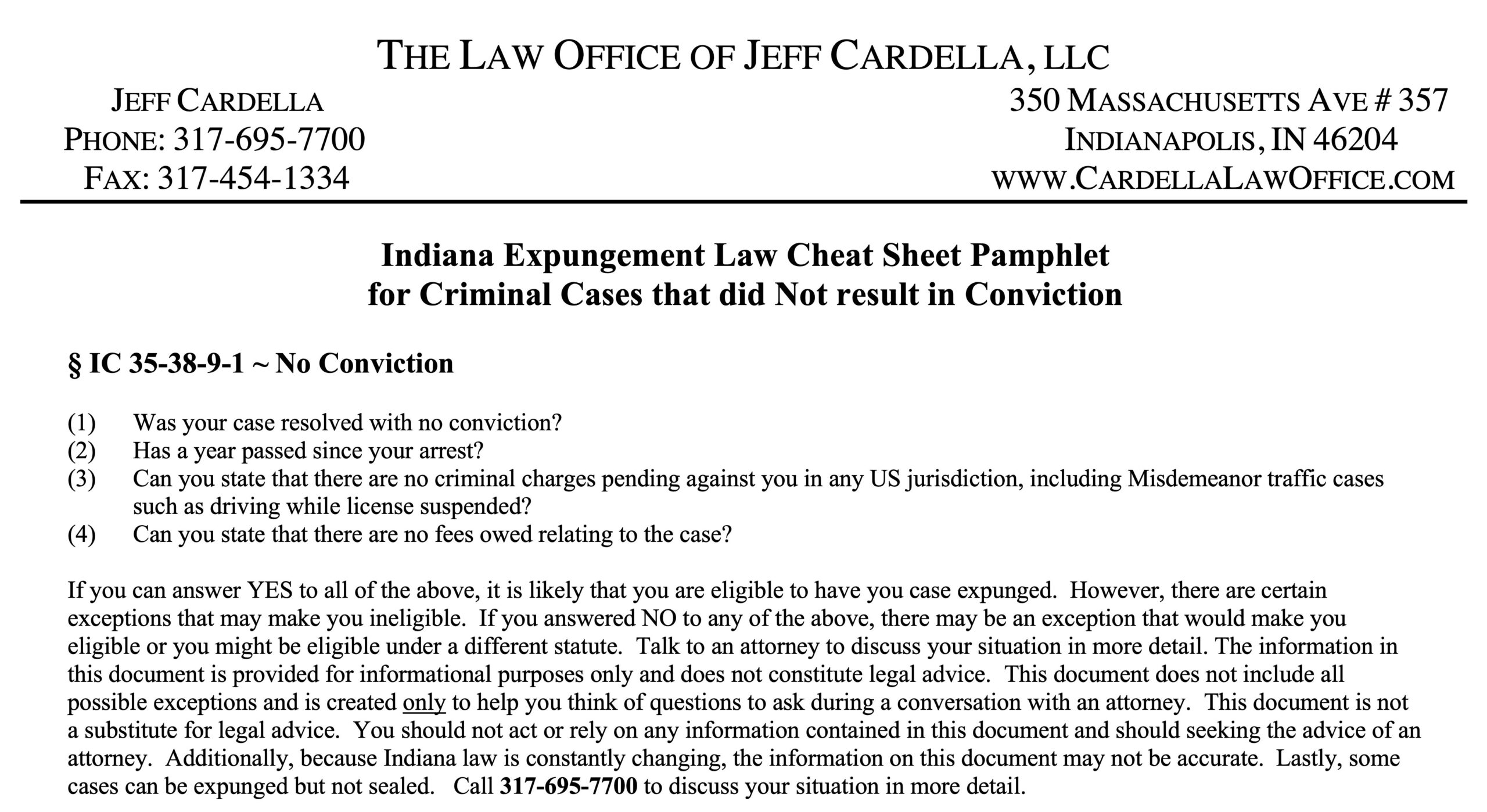
Indiana Expungement Law Cheat Sheet Pamphlet for Criminal Cases that Did Not Result in Conviction

Indiana expungement cheat sheet for cases that did not result in conviction

Indiana Expungement Law Cheat Sheet Pamphlet for Criminal Cases that Resulted in a Misdemeanor Conviction

Indiana expungement cheat sheet for misdemeanor conviction

Indiana Expungement Law Cheat Sheet Pamphlet for Criminal Cases that Resulted in a Level 6 or D Felony Conviction

Indiana expungement cheat sheet for low level felony conviction

Indiana Expungement Law Cheat Sheet Pamphlet for More Serious Felony Convictions

Indiana expungement cheat sheet for major felony conviction

Disclaimer

The information contained on this website is provided for educational and informational purposes only and should not be construed as legal advice or as an offer to perform legal services on any subject matter. The content of this website contains general information and may not reflect current legal developments or information. The information is not guaranteed to be correct, complete, or current. We make no warranty, expressed or implied, about the accuracy or reliability of the information at this website or at any other website to which it is linked. Recipients of content from this site should not act or refrain from acting on the basis of any information included in the site without seeking appropriate legal advice on the particular facts and circumstances at issue from an Indiana Criminal Defense attorney or an attorney licensed in the recipient’s state. Nothing herein is intended to create an attorney-client relationship and shall not be construed as legal advice. This is not an offer to represent you.

Table of Contents